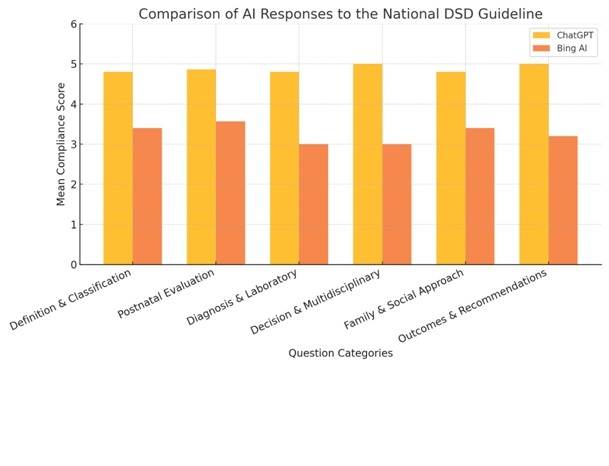
Objective: This study aims to compare the guideline compliance of two widely used AI-based chatbot systems, ChatGPT and Bing AI, with the clinical recommendations outlined in the Disorders of Sex Development (DSD) guideline published by the Turkish Neonatal Society. Materials and Methods: A standardized evaluation set comprising 40 questions based on the DSD guideline was utilized. The questions were grouped under six main categories reflecting clinical decision-making processes and were presented to both ChatGPT and Bing AI. Responses were scored on a 5-point Likert scale by two independent experts, assessing their alignment with the guideline. Mean scores were calculated for each category, and statistical comparisons were made using the Wilcoxon signed-rank test. Results: ChatGPT demonstrated high consistency with the guideline across all categories (mean score: 4.88), while Bing AI showed lower compliance in several areas (mean score: 3.25). The differences in scores between the two systems were statistically significant across all categories (p < 0.05), with Bing AI performing particularly poorly in the areas of diagnosis/laboratory testing and multidisciplinary approach. Conclusion: ChatGPT demonstrated higher accuracy and consistency than Bing AI in providing guideline-based clinical support regarding DSD. The use of AIsupported systems aligned with current guidelines holds significant potential in supporting complex, multidisciplinary decision-making processes. Therefore, the selection of AI tools in clinical settings should be informed by such systematic evaluations.
Cite this Article As :
Uygun SS, Ozcan Siki F. A Comparative Analysis of Large Language Models in Managing Disorders of Sex Development: Evaluation Based on Clinical Guidelines. Selcuk Med J 2025;41(4): 201-204
1. Özalp Kızılay D, Özen S. Current diagnostic approaches in the genetic diagnosis of disorders of sex development. J Clin Res Pediatr Endocrinol. 2024;16(4):401-10. doi: 10.4274/jcrpe.galenos.2024.2024-3-3.
2. Yavas AZ, Guran T. Diagnosis and management of non-CAH 46,XX disorders/differences in sex development. Front Endocrinol (Lausanne). 2024;15:1354759. doi: 10.3389/fendo.2024.1354759.
3. Ndoye NA, Diallo BA, Sylla M, et al. Ovotesticular disorders of sexual development: Diagnostic, therapeutic, and evolutionary aspects. J Pediatr Surg. 2025;60(4):162187. Doi: 10.1016/j.jpedsurg.2025.162187
4. Khorashad BS, Goodarzi H, Greenfield D, et al. Recommendations for 46,XY disorders/differences of sex development across two decades: Insights from North American pediatric endocrinologists and urologists. Arch Sex Behav. 2024;53(8):2939-56. doi.org/10.1007/s10508-024-02942-1
5. Altıntaş E, Kılıç R, Gürlek C, et al. Comparative analysis of artificial intelligence chatbot recommendations for urolithiasis management: A study of EAU guideline compliance. Fr J Urol. 2024;34(7-8):102666. doi: 10.1016/j.fjurol.2024.102666
6. Alasker, A., Alsalamah, S., Alshathri, N. et al. Performance of large language models (LLMs) in providing prostate cancer information. BMC Urol 24, 177 (2024). Doi:10.1186/s12894-024-01570-0.
7. Caglar U, Tunç F, Özen B, et al. Evaluating the performance of ChatGPT in answering questions related to pediatric urology. J Pediatr Urol. 2024;20(1):26.e1-5. doi: 10.1016/j.jpurol.2023.08.003.
8. Ranjan J, Gupta A, Mehta S, et al. Assessment of artificial intelligence platforms with regard to medical microbiology knowledge: An analysis of ChatGPT and Gemini. Cureus. 2024;16(5):e60675. doi: 10.7759/cureus.60675.
9. Akyol Onder EN, Ensari E, Ertan P. ChatGPT-4o's performance on pediatric vesicoureteral reflux. J Pediatr Urol. 2025 Apr;21(2):504-509. doi: 10.1016/j.jpurol.2024.12.002.
10. Sarikaya M, Ozcan Siki F, Ciftci I. Use of artificial intelligence in vesicoureteral reflux disease: A comparative study of guideline compliance. J Clin Med. 2025 Mar 30;14(7):2378. doi: 10.3390/jcm14072378.
11. Deniz MS, Guler BY. Assessment of ChatGPT's adherence to ETA-thyroid nodule management guideline over two different time intervals 14 days apart: In binary and multiple-choice queries. Endocrine. 2024;85(2):794-802. doi: 10.1007/s12020-024-03750-2.
12. Cakir H, Kaya Z, Tunçer M, et al. Evaluating the performance of ChatGPT in answering questions related to urolithiasis. Int Urol Nephrol. 2024;56(1):17-21. doi: 10.1007/s11255-023-03773-0
13. Cil G, Dogan K. The efficacy of artificial intelligence in urology: A detailed analysis of kidney stone-related queries. World J Urol. 2024;42(1):158. doi: 10.1007/s00345-024-04847-z.
14. Lee Y, Tessier L, Brar K, et al. Performance of artificial intelligence in bariatric surgery: Comparative analysis of ChatGPT-4, Bing, and Bard in the American Society for Metabolic and Bariatric Surgery textbook of bariatric surgery questions. Surg Obes Relat Dis. 2024;20(7):609-13. doi: 10.1016/j.soard.2024.04.014.
15. Klang E, Sourosh A, Nadkarni GN, et al. Evaluating the role of ChatGPT in gastroenterology: A comprehensive systematic review of applications, benefits, and limitations. Therap Adv Gastroenterol. 2023;16:17562848231218618. doi: 10.1177/17562848231218618.
16. Ríos-Hoyo A, Shan NL, Li A, et al. Evaluation of large language models as a diagnostic aid for complex medical cases. Front Med (Lausanne). 2024 Jun 20;11:1380148. doi: 10.3389/fmed.2024.1380148.
17. Lopez-Gonzalez R, Sanchez-Cordero S, Pujol-Gebellí J, et al. Evaluation of the Impact of ChatGPT on the Selection of Surgical Technique in Bariatric Surgery. Obes Surg. 2025 Jan;35(1):19-24. doi: 10.1007/s11695-024-07279-1.
 Research Paper
 View as PDF
 Keywords
Large Language Models, Disorders of Sex Development, Artificial Intelligence, Neonatology, Decision Support Systems
Keywords
Large Language Models, Disorders of Sex Development, Artificial Intelligence, Neonatology, Decision Support Systems