Objective: Diabetic nephropathy is one of the leading causes of chronic kidney disease and progression to end-stage renal failure. Identifying new biomarkers that
correlate with nephropathy severity may improve risk stratification and clinical decision-making processes. The aim of this study was to evaluate the relationship
between serum selenoprotein levels, renal function parameters, and proteinuria severity in newly diagnosed diabetes mellitus patients.
Materials and Methods: Ninety patients with diabetes mellitus were divided into three groups according to their proteinuria status: those without proteinuria (n=30),
those with microalbuminuria (30–300 mg/g, n=30), and those with macroalbuminuria (>300 mg/g, n=30). Demographic characteristics, glycemic indicators, renal
function tests, and serum selenoprotein P concentrations were evaluated.
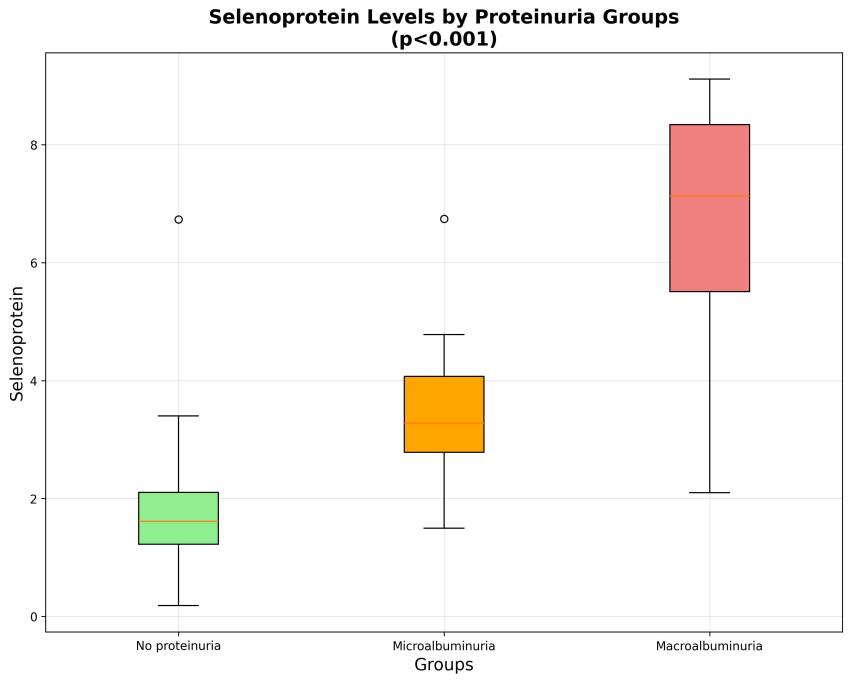
Results: Selenoprotein P levels showed a gradual increase across groups (1,61 [1,23–2,10], 3,28 [2,79–4,07], and 7,13 [5,51–8,34], respectively; p < 0,001). Proteinuria
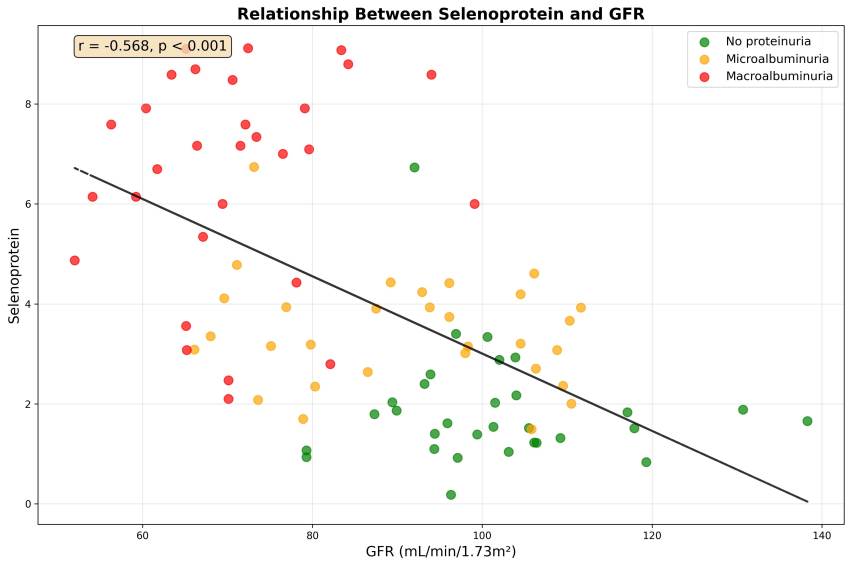
severity showed a strong positive correlation with selenoprotein P (r=0.794, p<0.001), creatinine (r=0.532, p<0.001), and HbA1c (r=0.406, p<0.001), and negatively
correlated with GFR (r=−0.681, p<0.001).
Conclusion: Increased selenoprotein P concentrations are closely associated with worsening proteinuria and renal dysfunction and support its potential as an early
biomarker of diabetic nephropathy.
Cite this Article As :
Ucar C, Yildizgoren MT, Goktepe MH, Ay A, Yarbas G, Ilanbey B. Association of Selenoprotein P Levels with Proteinuria Severity in Newly Diagnosed Type
2 Diabetes Mellitus. Selcuk Med J 2026;42(3): 219-223
1. Cade WT. Diabetes-related microvascular and macrovascular diseases in the physical therapy setting. Phys Ther. 2008;88(11):1322-35. doi:10.2522/ptj.20080008
2. Alicic RZ, Rooney MT, Tuttle KR. Diabetic Kidney Disease: Challenges, Progress, and Possibilities. Clin J Am Soc Nephrol. 2017;12(12):2032-45. doi:10.2215/CJN.11491116
3. Yang H, Chen Y, He J et al. Advances in the diagnosis of early biomarkers for acute kidney injury: a literature review. BMC Nephrol. 2025;26(1):115. doi:10.1186/s12882-025-04040-3
4. Glassock RJ. Is the presence of microalbuminuria a relevant marker of kidney disease?. Curr Hypertens Rep. 2010;12(5):364-8. doi:10.1007/s11906-010-0133-3
5. Thomas MC, Brownlee M, Susztak K et al. Diabetic kidney disease. Nat Rev Dis Primers. 2015;1:15018. doi:10.1038/nrdp.2015.18
6. Hariharan S, Dharmaraj S. Selenium and selenoproteins: it's role in regulation of inflammation. Inflammopharmacology. 2020;28(3):667-95. doi:10.1007/s10787-020-00690-x
8. Jha JC, Banal C, Chow BS et al. Diabetes and Kidney Disease: Role of Oxidative Stress. Antioxid Redox Signal. 2016;25(12):657-84. doi:10.1089/ars.2016.6664
9. Rocca C, Pasqua T, Boukhzar L et al. Progress in the emerging role of selenoproteins in cardiovascular disease: focus on endoplasmic reticulum-resident selenoproteins. Cell Mol Life Sci. 2019;76(20):3969-85. doi:10.1007/s00018-019-03195-1
10. Yu SS, Du JL. Current views on selenoprotein S in the pathophysiological processes of diabetes-induced atherosclerosis: potential therapeutics and underlying biomarkers. Diabetol Metab Syndr. 2024;16(1):5. doi:10.1186/s13098-023-01247-y
11. Bellinger FP, Raman AV, Reeves MA et al. Regulation and function of selenoproteins in human disease. Biochem J. 2009; 422 (1):11-22. doi: 10.1042/BJ20090219.
12. Valencia WM, Florez H. How to prevent the microvascular complications of type 2 diabetes beyond glucose control. BMJ. 2017;356:i6505. doi:10.1136/bmj.i6505
13. Nakatani S, Ishimura E, Naganuma T et al. Poor glycemic control and decreased renal function are associated with increased intrarenal RAS activity in Type 2 diabetes mellitus. Diabetes Res Clin Pract. 2014;105(1):40-6. doi:10.1016/j.diabres.2014.04.019
14. Muthukumar A, Badawy L, Mangelis A et al. HbA1c variability is independently associated with progression of diabetic kidney disease in an urban multi-ethnic cohort of people with type 1 diabetes. Diabetologia. 2024;67(9):1955-61. doi:10.1007/s00125-024-06197-2
15. Yang SJ, Hwang SY, Choi HY et al. Serum selenoprotein P levels in patients with type 2 diabetes and prediabetes: implications for insulin resistance, inflammation, and atherosclerosis. J Clin Endocrinol Metab. 2011;96(8):E1325-E1329. doi:10.1210/jc.2011-0620
 Research Paper
 View as PDF
 Keywords
Diabetic nephropathy, Proteinuria severity, SELENOPROTEİN P
Keywords
Diabetic nephropathy, Proteinuria severity, SELENOPROTEİN P