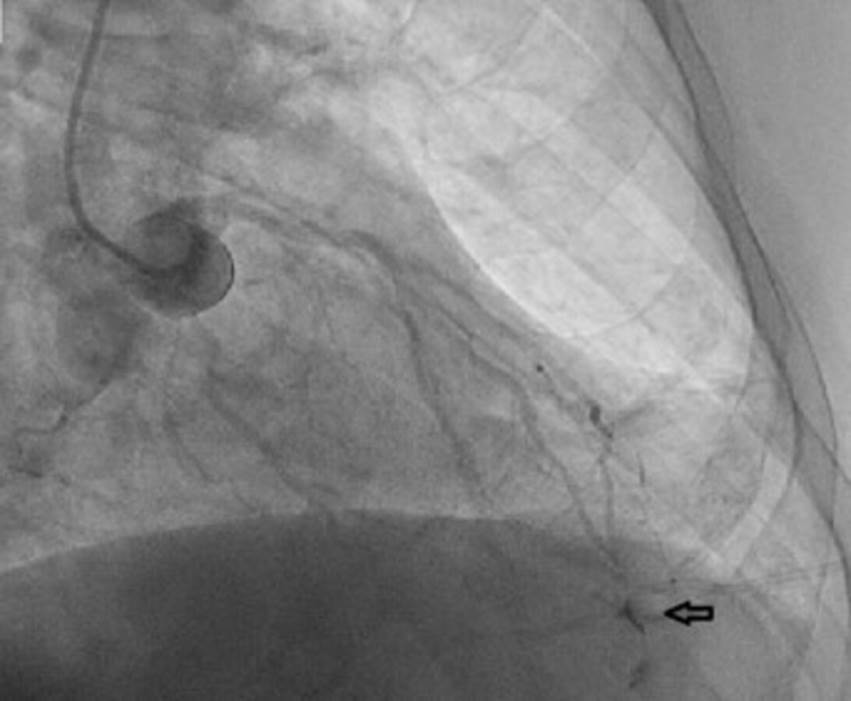
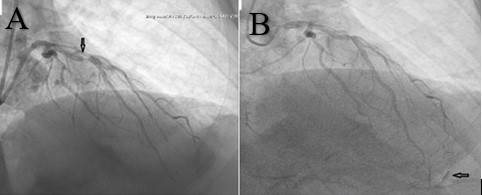
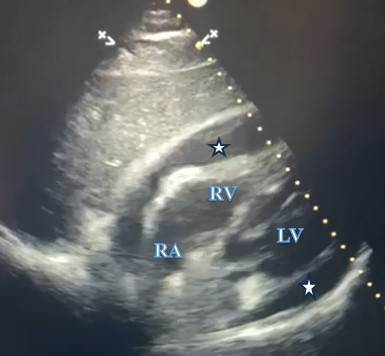
Although uncommon, coronary artery perforation (CAP) during percutaneous coronary intervention (PCI) can lead to serious, potentially fatal outcomes.The risk of CAP is notably higher during complex coronary interventions, particularly in cases involving chronic total occlusions (CTO) and heavily calcified lesions. Early recognition and prompt management of life-threatening consequences such as cardiac tamponade are critical for improving patient outcomes and reducing mortality. Management strategies vary depending on the severity and location of the perforation and may include prolonged balloon inflation, the implantation of covered stents, pericardiocentesis, or coil embolization for distal vessel perforations. In this report, we present a case of distal left anterior descending artery (LAD) perforation leading to cardiac tamponade, successfully managed with emergency pericardiocentesis and coil embolization.
Cite this Article As :
Aydin N, Soylu A, Alsancak Y. Delayed Distal LAD Perforation After Elective PCI: Successful Treatment with Coil Embolization. Selcuk Med J 2026;42(2):
202-205
1. OP Guttmann, DA Jones, A Gulati, et al. Prevalence and outcomes of coronary artery perforation during percutaneous coronary intervention. EuroIntervention, 2017, 13.5: e595-e601. Doi:10.4244/EIJ-D-16-01038
2. A Abdalwahab, M Farag, ES Brilakis, et al. Management of coronary artery perforation. Cardiovascular Revascularization Medicine, 2021, 26: 55-60. Doi:10.1016/j.carrev.2020.11.013
3. H Kawamoto, K Tanaka, N Ruparelia, et al. Short-term and long-term outcomes after polytetrafluoroethylene-covered stent implantation for the treatment of coronary perforation. The American Journal of Cardiology, 2015, 116.12: 1822-1826. Doi:10.1016/j.amjcard.2015.09.019
4. Albert Teis , Eduard Fernández-Nofrerías, Oriol Rodríguez-Leor, et al. Coronary artery perforation by intracoronary guidewires: risk factors and clinical outcomes. Revista Española de Cardiología (English Edition), 2010, 63.6: 730-734. Doi:10.1016/s1885-5857(10)70148-1
5. XENOGIANNIS, Iosif; BRILAKIS, Emmanouil S. Advances in the treatment of coronary perforations. Catheterization and Cardiovascular Interventions, 2019, 93.5: 921-922. Doi:10.1002/ccd.28205
6. Mateusz Sucharski , Małgorzata Kurpaska , Michał Malinowski , et al. New Techniques in Iatrogenic Coronary Artery Perforation Management Including Umbrella Technique, Case Report. Cardiovascular Revascularization Medicine, 2023, 53: S245-S249. Doi:10.1016/j.carrev.2023.05.003
7. SH Alavi, M Hassanzadeh, P Dehghani, et al. A novel technique for managing guidewire-induced distal coronary perforation using coronary balloon pieces. Case Reports, 2022, 4.3: 137-141. Doi:10.1016/j.jaccas.2021.10.018



 Keywords