Diagnostic Value of Preoperative Imaging Modalities and Their Association with Clinical Parameters in Lesion Localization in Primary Hyperparathyroidism
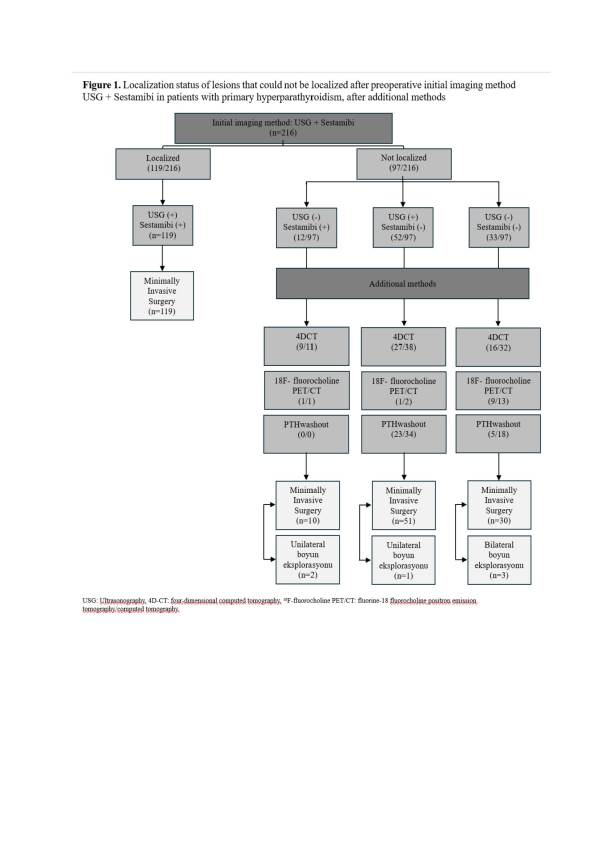
Objective: The aim of the study was to assess the diagnostic value of preoperative imaging modalities for identifying primary hyperparathyroidism (PHPT) and to examine the clinical and biochemical characteristics associated with successful lesion localization. Materials and Methods: Data from 216 patients who underwent parathyroidectomy for PHPT and had successful preoperative localization from neck ultrasonography (USG) and Tc-99m sestamibi scintigraphy were analyzed retrospectively. Cases that were not initially localized by imaging were evaluated based on 4D-CT or 18F-fluorocholine PET/CT reports. The associations between accurate localization with imaging modalities and the clinical and biochemical characteristics were investigated. Results: The combined use of neck USG and Tc-99m sestamibi scintigraphy had a sensitivity of 55.1% and a positive predictive value of 96.3% for detecting hyperfunctional lesions. Multivariable analysis revealed that a parathyroid gland size greater than 1 cm (odds ratio [OR]=2.521, p=0.002), serum intact parathyroid hormone (iPTH) concentration greater than 134 ng/L (OR=2.270, p=0.007), and the presence of normocalcemic PHPT (OR=2.546, p=0.023) were independently associated with successful localization when using USG and sestamibi scintigraphy together. Conclusions: Combined neck USG and Tc-99m sestamibi scintigraphy are particularly effective for localizing of PHPT in patients with larger glands, higher iPTH levels, and normocalcemic PHPT, potentially obviating the need for advanced imaging in selected cases.
Cite this Article As :
Gokbulut P, Muhurdaroglu AM, Onder CE, Taskaldiran I, Demirel MK, Poyrazer M, Kuskonmaz SM, Korkmaz M. Diagnostic Value of Preoperative Imaging
Modalities and Their Association with Clinical Parameters in Lesion Localization in Primary Hyperparathyroidism. Selcuk Med J 2026;42(2): 158-167
1- Hunter GJ, Schellingerhout D, Vu TH, et al. Accuracy of four-dimensional CT for the localization of abnormal parathyroid glands in patients with primary hyperparathyroidism. Radiology. 2012;264(3):789-795. doi: 10.1148/radiol.12110852.
2- Hindié E, Schwartz P, Avram AM, et al. Primary hyperparathyroidism: defining the appropriate preoperative imaging algorithm. J Nucl Med. 2021;62(Suppl 2):3S-12S. doi: 10.2967/jnumed.120.245993.
3- Yeh R, Tay YD, Tabacco G, et al. Diagnostic performance of 4D CT and sestamibi SPECT/CT in localizing parathyroid adenomas in primary hyperparathyroidism. Radiology. 2019;291(2):469-476. doi: 10.1148/radiol.2019182122.
4- Kuzminski SJ, Sosa JA, Hoang JK. Update in parathyroid imaging. Magn Reson Imaging Clin N Am. 2018;26(1):151-166. doi: 10.1016/j.mric.2017.08.009.
5- Smith RB, Evasovich M, Girod DA, et al. Ultrasound for localization in primary hyperparathyroidism. Otolaryngol Head Neck Surg. 2013;149(3):366-371. doi: 10.1177/0194599813491063.
6- Adkisson CD, Koonce SL, Heckman MG, et al. Predictors of accuracy in preoperative parathyroid adenoma localization using ultrasound and Tc-99m sestamibi: a 4-quadrant analysis. Am J Otolaryngol. 2013;34(5):508-516. doi: 10.1016/j.amjoto.2013.05.001.
7- Haber RS, Kim CK, Inabnet WB. Ultrasonography for preoperative localization of enlarged parathyroid glands in primary hyperparathyroidism: comparison with technetium sestamibi scintigraphy. Clin Endocrinol (Oxf). 2002;57(2):241-249. doi: 10.1046/j.1365-2265.2002.01583.x.
8- Joshi SP, Chowdhary J, Gupta S, et al. Why? What? When? Utility of 4DCT in the preoperative imaging algorithm of primary hyperparathyroidism. SA J Radiol. 2025 ;29(1):3094. doi: 10.4102/sajr.v29i1.3094.
9- Bilezikian JP, Khan AA, Clarke BL, et al. The Fifth International Workshop on the Evaluation and Management of Primary Hyperparathyroidism. J Bone Miner Res. 2022;37(11):2290-2292. doi: 10.1002/jbmr.4670.
10- Liu Y, Sinha GN, Andreopoulou P, et al. Approach to the Patient: Normocalcemic Primary Hyperparathyroidism. J Clin Endocrinol Metab. 2025 ;110(3):e868-e877. doi: 10.1210/clinem/dgae659.
11- Nasiri S, Soroush A, Hashemi AP, et al. Parathyroid adenoma Localization. Med J Islam Repub Iran. 2012;26(3):103-9.
12- Day KM, Elsayed M, Beland MD, et al. The utility of 4-dimensional computed tomography for preoperative localization of primary hyperparathyroidism in patients not localized by sestamibi or ultrasonography. Surgery. 2015;157(3):534-9. doi: 10.1016/j.surg.2014.11.010.
13- Balci G, Bahçecioğlu AB, Avcı Merdin F, et al. A stepwise approach to localization studies in primary hyperparathyroidism. Acta Endocrinol (Buchar). 2024;20(3):311-317. doi: 10.4183/aeb.2024.311.
14- Lo CY, Lang BH, Chan WF, et al. A prospective evaluation of preoperative localization by technetium-99m sestamibi scintigraphy and ultrasonography in primary hyperparathyroidism. Am J Surg. 2007;193(2):155-159. doi: 10.1016/j.amjsurg.2006.04.020.
15- Berber E, Parikh RT, Ballem N, et al. Factors contributing to negative parathyroid localization: an analysis of 1000 patients. Surgery. 2008;144(1):74-79. doi: 10.1016/j.surg.2008.03.019.
16- Ozderya A, Temizkan S, Cetin K, et al. The results of parathyroid hormone assay in parathyroid aspirates in preoperative localization of parathyroid adenomas for focused parathyroidectomy in patients with negative or suspicious technetium-99m-sestamibi scans. Endocr Pract. 2017;23(9):1101-1106. doi: 10.4158/EP171921.OR.
17- Hughes DT, Sorensen MJ, Miller BS, et al. The biochemical severity of primary hyperparathyroidism correlates with the localization accuracy of sestamibi and surgeon-performed ultrasound. J Am Coll Surg. 2014;219(5):1010-9. doi: 10.1016/j.jamcollsurg.2014.06.020.
18- Kandil E, Tufaro AP, Carson KA, et al. Correlation of plasma 25-hydroxyvitamin D levels with severity of primary hyperparathyroidism and likelihood of parathyroid adenoma localization on sestamibi scan. Arch Otolaryngol Head Neck Surg. 2008 ;134(10):1071-5. doi: 10.1001/archotol.134.10.1071.
19- Tassone F, Castellano E, Gianotti L, et al. Vitamin D deficiency does not affect the likelihood of presurgical localization in asymptomatic primary hyperparathyroidism. Endocr Pract. 2016;22(2):205-209. doi: 10.4158/EP15977.OR.
20- Filser B, Uslar V, Weyhe D, et al. Predictors of adenoma size and location in primary hyperparathyroidism. Langenbecks Arch Surg. 2021;406(5):1607-1614. doi: 10.1007/s00423-021-02179-9.
21- Panarese A, D’Andrea V, Pontone S, et al. Management of concomitant hyperparathyroidism and thyroid diseases in elderly patients: a retrospective cohort study. Aging Clin Exp Res. 2017;29(Suppl 1):29-33. doi: 10.1007/s40520-016-0665-8.
22- Heizmann O, Viehl CT, Schmid R, et al. Impact of concomitant thyroid pathology on preoperative workup for primary hyperparathyroidism. Eur J Med Res. 2009 ;14(1):37-41. doi: 10.1186/2047-783x-14-1-37.
23- Ryan S, Courtney D, Timon C. Co-existent thyroid disease in patients treated for primary hyperparathyroidism: implications for clinical management. Eur Arch Otorhinolaryngol. 2015 Feb;272(2):419-23. doi: 10.1007/s00405-014-3000-z. Epub 2014 Mar 15. PMID: 24633247.
24- Bentrem DJ, Angelos P, Talamonti MS, et al. Is preoperative investigation of the thyroid justified in patients undergoing parathyroidectomy for hyperparathyroidism? Thyroid.2002;12(12):1109-12. doi: 10.1089/105072502321085207.
25- Masatsugu T, Yamashita H, Noguchi S, et al. Significant clinical differences in primary hyperparathyroidism between patients with and those without concomitant thyroid disease. Surg Today. 2005;35(5):351-6. doi: 10.1007/s00595-004-2952-9.
26- Kösem M, Algün E, Kotan C, et al. Coexistent thyroid pathologies and high rate of papillary cancer in patients with primary hyperparathyroidism: controversies about minimal invasive parathyroid surgery. Acta Chir Belg. 2004;104(5):568-71. doi: 10.1080/00015458.2004.11679616.
27- Bancos I, Grant CS, Nadeem S, et al. Risks and benefits of parathyroid fine-needle aspiration with parathyroid hormone washout. Endocr Pract. 2012;18(4):441-9. doi: 10.4158/EP11148.OR.
 Research Paper
 View as PDF
 Keywords
Primary hyperparathyroidism, neck ultrasonography, Tc-99m sestamibi scintigraphy, 4-dimensional CT, 18F-choline PET/CT
Keywords
Primary hyperparathyroidism, neck ultrasonography, Tc-99m sestamibi scintigraphy, 4-dimensional CT, 18F-choline PET/CT