ABSTRACT
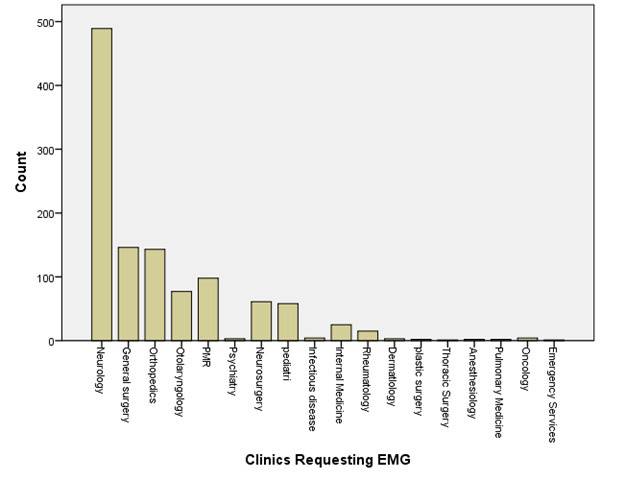
Objective: Electrodiagnostic studies encompass nerve conduction studies and needle electromyography. The rationale behind the requests and diagnostic concordance according to referring clinic, coupled with escalating healthcare expenditures, have garnered considerable scholarly attention and been the focus of studies. Our study aims to compare the consistency of referred cases according to clinic and the interpretation of nerve conduction studies and needle electromyography studies, comparing the findings with previous studies evaluating electromyography requests. Patients and Methods: In this study, data were included from 1136 patients, consisting of 590 women and 549 men who underwent electrodiagnostic examinations in our laboratory over a period of two years. These data were retrospectively analyzed, and the findings were evaluated in terms of demographic characteristics, reasons for referral, results, referring clinics, and diagnostic concordance. Results: Electromyographic investigations were found to have a general pathology detection rate of approximately 60%. The preliminary diagnoses most requested were polyneuropathy and entrapment neuropathy, respectively. Most entrapment neuropathy referrals were from Orthopedics (60%), while the majority of polyneuropathy requests came from Neurology and Internal Medicine. Tests were reported as pathological in more than half of the cases. The overall concordance rate was found to be 44.8%. When examining the concordance between the referral diagnosis and the final diagnosis for entrapment neuropathies, the Physical Medicine and Rehabilitation clinic exhibited the highest rate at 42%. The rate of discrepancy between referral and outcome was significantly high in referrals with multiple indications. Conclusion: The usefulness of electromyography for diagnosis and treatment is closely associated with pre-diagnostic considerations and the department responsible for the request. The concordance between referrals and outcomes can be predicted. Keywords: Neurological diagnostic technique, nerve conduction study, electromyography, tertiary referral center
Cite this Article As :
Turkmen N, Kir HH, Guney F, Yuruten Corbacioglu B, Demir O, Uyar M. Evaluation of Electromyography Requests in a Tertiary Center.
Selcuk Med J 2025;41(2): 71-77
1. Cocito D, Tavella A, Ciaramitaro P, et al. A further critical evaluation of requests for electrodiagnostic examinations. Neurol Sci. 2006;26(6):419–22. https://doi.org/10.1007/s10072-006-0525-y
2. Mondelli M, Giacchi M, Federico A. Requests for electromyography from general practitioners and specialists: critical evaluation. Ital J Neurol Sci. 1998;19(4):195–203. https://doi.org/10.1007/BF02427600
3. Podnar S. Critical reappraisal of referrals to electromyography and nerve conduction studies. Eur J Neurol. 2005;12(2):150–5. https://doi.org/10.1111/j.1468-1331.2004.00979.x
4. Bergquist ER, Hammert WC. Timing and appropriate use of electrodiagnostic studies. Hand Clin. 2013;29(3):363–70. https://doi.org/10.1016/j.hcl.2013.04.005
5. George D, Campbell L, Marra J. Diagnostic Uncertainty in Cervical Radiculopathy. Military Medicine. 2023;188(7-8):e2797-e2801. https://doi.org/10.1093/milmed/usac239
6. Horlings CG, Rath J, Finsterer J, et al. Laboratory Tests for Neuropathies: What to do and to Avoid. Journal of Neuromuscular Diseases. 2020;7(3):279-286. DOI: 10.3233/JND-200488
7. Podnar S, Rodi Z, Lukanovič A, et al. Standardization of anal sphincter EMG: technique of needle examination. Muscle Nerve Off J Am Assoc Electrodiagn Med. 1999;22(3):400–3. https://doi.org/10.1002/(SICI)1097-4598(199903)22:33.0.CO;2-L
8. Stålberg E, van Dijk H, Falck B, et al. Standards for quantification of EMG and neurography. Clin Neurophysiol. 2019;130(9):1688–729. https://doi.org/10.1016/j.clinph.2019.05.008
9. Bischoff C, Fuglsang-Fredriksen A, Vendelbo L, et al. Standards of instrumentation of EMG. The International Federation of Clinical Neurophysiology. Electroencephalogr Clin Neurophysiol Suppl. 1999;52:199–211. PMID: 10590988
10. Tankisi H, Burke D, Cui L, et al. Standards of instrumentation of EMG. Clin Neurophysiol. 2020;131(1):243–58. https://doi.org/10.1016/j.clinph.2019.07.025
11. Nikolic A, Stevic Z, Peric S, et al. Evaluation of the adequacy of requests for electrodiagnostic examination in a tertiary referral center. Clin Neurol Neurosurg. 2016;148:130–6. https://doi.org/10.1016/j.clineuro.2016.07.021
12. Turkmen N, Yuruten B, Guney F. An EMG Case Report with Shoulder Injury Presenting with Isolated High Ulnar Neuropathy. Selcuk Med J. 2022;38(2):102–5. DOI: 10.30733/std.2022.01544
13. Jones LK. Nerve conduction studies: basic concepts and patterns of abnormalities. Neurol Clin. 2012;30(2):405–27. DOI: 10.1016/j.ncl.2011.12.002
14. Ohmori N, Watanabe S, Momose H, et al. Investigation of variation factors in EMG measurement of swallowing: instruction can improve EMG reproducibility. Medical & Biological Engineering & Computing, 2022;60(10):2825-40. https://doi.org/10.1007/s11517-022-02590-4
15. Zewde YZ, Ayele BA, Belay HD, et al. Electrodiagnostic referrals and neuromuscular disease pattern in East Africa: Experience from a tertiary hospital in Ethiopia. Clin Neurophysiol Pract. 2022;7:65–70. https://doi.org/10.1016/j.cnp.2022.02.001
16. Jensen TS, Karlsson P, Gylfadottir SS, et al. Painful and non-painful diabetic neuropathy, diagnostic challenges and implications for future management. Brain. 2021;144(6):1632-45. https://doi.org/10.1093/brain/awab079
17. Tsao B. The electrodiagnosis of cervical and lumbosacral radiculopathy. Neurol Clin. 2007;25(2):473–94. https://doi.org/10.1016/j.ncl.2007.02.001
18. AANEM. Proper performance and interpretation of electrodiagnostic studies. Muscle Nerve. 2015;51:468–471.
19. Zambelis T. The usefulness of electrodiagnostic consultation in an outpatient clinic. J Clin Neurosci. 2019;67:59–61. https://doi.org/10.1016/j.jocn.2019.06.022
20. Stewart JD. Fokal Periferal Nöropatiler. (Çeviri editörleri: A.Emre ÖGE-Zeliha Matur) Türkçe 1. Basım. İstanbul: Doğa Yayınları, 2015:65-68.
21. Dumitru D. Focal peripheric neuropathies. In: Dumitru D (ed). Electrodiagnostic Medicine. 1st ed. Philadelphia: Henley & Bel- fus, 1995:851-927.
22. Atroshi I, Gummesson C, Johnsson R, et al. Prevalence of carpal tunnel syndrome in a general population. Jama. 1999;282(2):153–8. doi:10.1001/jama.282.2.153
23. Andrews PI, Massey JM, Howard JF, et al. Race, sex, and puberty influence onset, severity, and outcome in juvenile myasthenia gravis. Neurology. 1994;44(7):1208–1208. https://doi.org/10.1212/WNL.44.7.1208
24. Nardin RA, Rutkove SB, Raynor EM. Diagnostic accuracy of electrodiagnostic testing in the evaluation of weakness. Muscle Nerve Off J Am Assoc Electrodiagn Med. 2002;26(2):201–5. https://doi.org/10.1002/mus.10192
25. LeBlanc KE, Cestia W. Carpal tunnel syndrome. Am Fam Physician. 2011;83(8):952-8.



 Keywords