Investigation of Morphine-Induced Dopamine Release in the Nucleus Accumbens by Fiber Photometry
Yasin Ali Çimen, Selim Kutlu
- Year : 2025
- Vol : 41
- Issue : 4
- Page :
194-200
Objective: Morphine is an opiate frequently used in the management of acute and chronic pain. Sequential use of morphine increases dopamine levels in the nucleus accumbens (NAc) through activation of dopaminergic neurons in the ventral tegmental area. The aim of the study was to investigate dopaminergic signals in the NAc during morphine dependence and withdrawal using fiber photometry system with dopaminergic sensor (GRABDA).
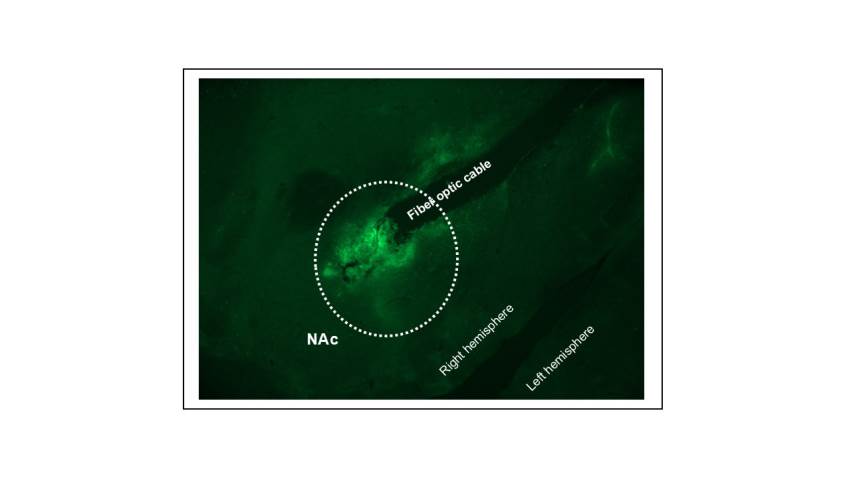
Materials and Methods: Male Wistar rats were divided into two groups as morphine (M) and morphine+naloxone (M+N). GRABDA was injected into the right NAc region. GRABDA contains a recognition domain based on the dopamine receptor 2 (DRD2) in its structure. When dopamine binds to this domain, the green fluorescent protein in the sensor is activated. The resulting fluorescence change reflects dopaminergic activity and signal transmission in the region. Afterwards, a fiber optic cable was fixed to NAc. After 15 days of rest, 10mg/kg morphine was injected intraperitoneally for 5 days. 3mg/kg naloxone was injected into the M+N group after the last injection. Average ΔF/F (%) values expressing dopaminergic signalling were calculated with Python after collecting fiber photometric records. The ΔF/F (%) value expresses the normalised level of dopamine binding to DRD2 receptors as a percentage. Statistical comparisons were made using a mixed-ANOVA test and post-hoc comparisons were made using estimated marginal means.
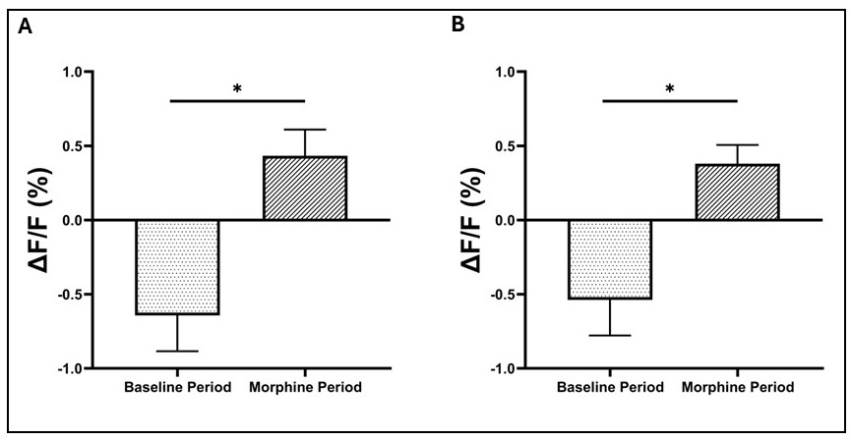
Results: The ΔF/F (%) values of the M and M+N groups increased with morphine injection compared to baseline period (p<0.05). As a result of naloxone injections, the ΔF/F (%) values of the M+N group significantly decreased compared to the M group (p<0.05). Morphine addiction increases dopaminergic signalling in the NAc, while naloxone suppresses this effect.
Conclusions: Fiber photometry with a novel biosensors enables more efficient detection of dopaminergic activity compared to older methods such as liquid chromatography. Further studies are needed for a better understanding of specific neuronal and regional processes.
Cite this Article As :
Cimen YA, Kutlu S. Investigation of Morphine-Induced Dopamine Release in the Nucleus Accumbens by Fiber Photometry. Selcuk Med J 2025;41(4): 194-200
Download Citation: Endnote/Zotero/Mendeley (RIS) RIS File
Download Citation: BibTeX BibTeX File
Description :
None of the authors, any product mentioned in this article,
does not have a material interest in the device or drug. Research,
not supported by any external organization.
grant full access to the primary data and, if requested by the magazine
they agree to allow the examination of data.
Investigation of Morphine-Induced Dopamine Release in the Nucleus Accumbens by Fiber Photometry
2025,
Vol.
41
(4)
Received : 30.01.2025,
Accepted : 04.06.2025,
Published Online : 11.12.2025
Selcuk Medical Journal
ISSN:1017-6616;
E-ISSN:2149-8059;
 Research Paper
 View as PDF
 Keywords
addiction, dopamine, fiber photometry, grab sensors, morphine, naloxone, rat.
Keywords
addiction, dopamine, fiber photometry, grab sensors, morphine, naloxone, rat.