Investigation of Morphine-Induced Dopamine Release in the Nucleus Accumbens by Fiber Photometry

Yasin Ali Çimen, Selim Kutlu

  • Year : 2025
  • Vol : 41
  • Issue : 4
  •  Page : 194-200
Objective: Morphine is an opiate frequently used in the management of acute and chronic pain. Sequential use of morphine increases dopamine levels in the nucleus accumbens (NAc) through activation of dopaminergic neurons in the ventral tegmental area. The aim of the study was to investigate dopaminergic signals in the NAc during morphine dependence and withdrawal using fiber photometry system with dopaminergic sensor (GRABDA).
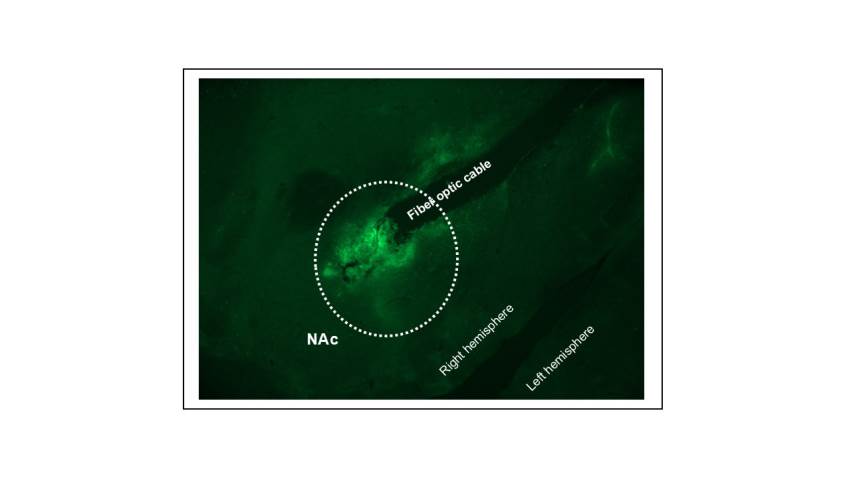
Materials and Methods: Male Wistar rats were divided into two groups as morphine (M) and morphine+naloxone (M+N). GRABDA was injected into the right NAc region. GRABDA contains a recognition domain based on the dopamine receptor 2 (DRD2) in its structure. When dopamine binds to this domain, the green fluorescent protein in the sensor is activated. The resulting fluorescence change reflects dopaminergic activity and signal transmission in the region. Afterwards, a fiber optic cable was fixed to NAc. After 15 days of rest, 10mg/kg morphine was injected intraperitoneally for 5 days. 3mg/kg naloxone was injected into the M+N group after the last injection. Average ΔF/F (%) values expressing dopaminergic signalling were calculated with Python after collecting fiber photometric records. The ΔF/F (%) value expresses the normalised level of dopamine binding to DRD2 receptors as a percentage. Statistical comparisons were made using a mixed-ANOVA test and post-hoc comparisons were made using estimated marginal means.
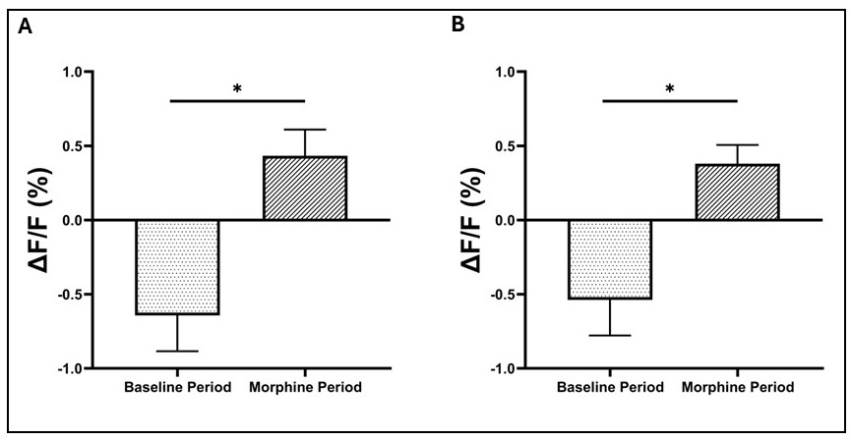
Results: The ΔF/F (%) values of the M and M+N groups increased with morphine injection compared to baseline period (p<0.05). As a result of naloxone injections, the ΔF/F (%) values of the M+N group significantly decreased compared to the M group (p<0.05). Morphine addiction increases dopaminergic signalling in the NAc, while naloxone suppresses this effect.
Conclusions: Fiber photometry with a novel biosensors enables more efficient detection of dopaminergic activity compared to older methods such as liquid chromatography. Further studies are needed for a better understanding of specific neuronal and regional processes.
Cite this Article As : Cimen YA, Kutlu S. Investigation of Morphine-Induced Dopamine Release in the Nucleus Accumbens by Fiber Photometry. Selcuk Med J 2025;41(4): 194-200

Download Citation: Endnote/Zotero/Mendeley (RIS) RIS File

Download Citation: BibTeX BibTeX File

Conflict of interest : The authors declare that they have no conflict of interest.
Selcuk Medical Journal
2025, Vol. 41 (4)
ISSN: 1017-6616
E-ISSN: 2149-8059
Received : , Accepted : , Published Online :

References

  1. 1. Carroll I R, Angst M S and Clark D J, Management of perioperative pain in patients chronically consuming opioids. Regional Anesthesia & Pain Medicine, 2004; 29(6):576-591. https://doi.org/10.1016/j.rapm.2004.06.009.
  2. 2. Haghparast A, Khani A, Naderi N, et al., Repeated administration of nicotine attenuates the development of morphine tolerance and dependence in mice. Pharmacology Biochemistry and Behavior, 2008; 88(4):385-392. https://doi.org/10.1016/j.pbb.2007.09.010.
  3. 3. Bart G, Maintenance medication for opiate addiction: the foundation of recovery. Journal of addictive diseases, 2012; 31(3):207-225. https://doi.org/10.1080/10550887.2012.694598.
  4. 4. Dhaliwal A and Gupta M, Physiology, opioid receptor. 2019.
  5. 5. Devine D P and Wise R A, Self-administration of morphine, DAMGO, and DPDPE into the ventral tegmental area of rats. Journal of Neuroscience, 1994; 14(4):1978-1984. 10.1523/JNEUROSCI.14-04-01978.1994.
  6. 6. Matthes H W, Maldonado R, Simonin F, et al., Loss of morphine-induced analgesia, reward effect and withdrawal symptoms in mice lacking the µ-opioid-receptor gene. Nature, 1996; 383(6603):819-823. https://doi.org/10.1038/383819a0.
  7. 7. Sora I, Takahashi N, Funada M, et al., Opiate receptor knockout mice define μ receptor roles in endogenous nociceptive responses and morphine-induced analgesia. Proceedings of the National Academy of Sciences, 1997; 94(4):1544-1549. https://doi.org/10.1073/pnas.94.4.1544.
  8. 8. Schulteis G, Heyser C and Koob G, Differential expression of response-disruptive and somatic indices of opiate withdrawal during the initiation and development of opiate dependence. Behavioural pharmacology, 1999; 10(3):235-242.
  9. 9. Massaly N, Copits B A, Wilson-Poe A R, et al., Pain-induced negative affect is mediated via recruitment of the nucleus accumbens kappa opioid system. Neuron, 2019; 102(3):564-573. e6. 10.1016/j.neuron.2019.02.029.
  10. 10. Li C, Sugam J A, Lowery-Gionta E G, et al., Mu opioid receptor modulation of dopamine neurons in the periaqueductal gray/dorsal raphe: a role in regulation of pain. Neuropsychopharmacology, 2016; 41(8):2122-2132. https://doi.org/10.1038/npp.2016.12.
  11. 11. Kielbinski M and Bernacka J, Fiber photometry in neuroscience research: principles, applications, and future directions. Pharmacological Reports, 2024; 76(6):1242-1255. https://doi.org/10.1007/s43440-024-00646-w.
  12. 12. Spanagel R, Herz A and Shippenberg T S, The effects of opioid peptides on dopamine release in the nucleus accumbens: an in vivo microdialysis study. Journal of neurochemistry, 1990; 55(5):1734-1740. https://doi.org/10.1111/j.1471-4159.1990.tb04963.x.
  13. 13. Jalabert M, Bourdy R, Courtin J, et al., Neuronal circuits underlying acute morphine action on dopamine neurons. Proceedings of the national academy of sciences, 2011; 108(39):16446-16450. https://doi.org/10.1073/pnas.1105418108.
  14. 14. Yun I A, Wakabayashi K T, Fields H L, et al., The ventral tegmental area is required for the behavioral and nucleus accumbens neuronal firing responses to incentive cues. Journal of Neuroscience, 2004; 24(12):2923-2933.
  15. 15. Koob G F, Neural mechanisms of drug reinforcement. Annals of the new York Academy of Sciences, 1992; 654:171-191. https://doi.org/10.1111/j.1749-6632.1992.tb25966.x.
  16. 16. Nicola S, Taha S, Kim S, et al., Nucleus accumbens dopamine release is necessary and sufficient to promote the behavioral response to reward-predictive cues. Neuroscience, 2005; 135(4):1025-1033. https://doi.org/10.1016/j.neuroscience.2005.06.088.
  17. 17. Björklund A and Dunnett S B, Dopamine neuron systems in the brain: an update. Trends in neurosciences, 2007; 30(5):194-202. 10.1016/j.tins.2007.03.006.
  18. 18. Snyder S H, Taylor K M, Coyle J T, et al., The role of brain dopamine in behavioral regulation and the actions of psychotropic drugs. American Journal of Psychiatry, 1970; 127(2):199-207. https://doi.org/10.1176/ajp.127.2.199.
  19. 19. Wise R A, Brain reward circuitry: insights from unsensed incentives. Neuron, 2002; 36(2):229-240.
  20. 20. Missale C, Nash S R, Robinson S W, et al., Dopamine receptors: from structure to function. Physiological reviews, 1998. https://doi.org/10.1152/physrev.1998.78.1.189.
  21. 21. Undieh A S, Pharmacology of signaling induced by dopamine D1-like receptor activation. Pharmacology & therapeutics, 2010; 128(1):37-60. https://doi.org/10.1016/j.pharmthera.2010.05.003.
  22. 22. Channer B, Matt S M, Nickoloff-Bybel E A, et al., Dopamine, immunity, and disease. Pharmacological reviews, 2023; 75(1):62-158. https://doi.org/10.1124/pharmrev.122.000618.
  23. 23. Gilbert J G, Newman A H, Gardner E L, et al., Acute administration of SB‐277011A, NGB 2904, or BP 897 inhibits cocaine cue‐induced reinstatement of drug‐seeking behavior in rats: Role of dopamine D3 receptors. Synapse, 2005; 57(1):17-28. https://doi.org/10.1002/syn.20152.
  24. 24. Longoni R, Spina L and Di Chiara G, Dopaminergic D-1 receptors: essential role in morphine-induced hypermotility. Psychopharmacology, 1987; 93:401-402.
  25. 25. Di Chiara G and Imperato A, Drugs abused by humans preferentially increase synaptic dopamine concentrations in the mesolimbic system of freely moving rats. Proceedings of the National Academy of Sciences, 1988; 85(14):5274-5278. https://doi.org/10.1073/pnas.85.14.5274.
  26. 26. Shahani P, Abolghasemi H, Abtin S, et al., The interaction effects between opioidergic and D1-like dopamine receptors in the nucleus accumbens on pain-related behaviors in the animal model of acute pain. Pharmacology Biochemistry and Behavior, 2025; 246:173911. https://doi.org/10.1016/j.pbb.2024.173911.
  27. 27. Sourty M, Nasseef M T, Champagnol-Di Liberti C, et al., Manipulating ΔFOSB in D1-Type Medium Spiny Neurons of the Nucleus Accumbens Reshapes Whole-Brain Functional Connectivity. Biological psychiatry, 2024; 95(3):266-274. https://doi.org/10.1016/j.biopsych.2023.07.013.
  28. 28. Blanco-Pozo M, Akam T and Walton M E, Dopamine-independent state inference mediates expert reward guided decision making. bioRxiv, 2021:2021.06. 25.449995. https://doi.org/10.1101/2021.06.25.449995.
  29. 29. Spanagel R, Herz A and Shippenberg T S, Opposing tonically active endogenous opioid systems modulate the mesolimbic dopaminergic pathway. Proceedings of the National Academy of Sciences, 1992; 89(6):2046-2050. https://doi.org/10.1073/pnas.89.6.2046.
  30. 30. Chefer V I, Kieffer B L and Shippenberg T S, Basal and morphine‐evoked dopaminergic neurotransmission in the nucleus accumbens of MOR‐and DOR‐knockout mice. European Journal of Neuroscience, 2003; 18(7):1915-1922. https://doi.org/10.1046/j.1460-9568.2003.02912.x.
  31. 31. Johnson S and North R, Opioids excite dopamine neurons by hyperpolarization of local interneurons. Journal of neuroscience, 1992; 12(2):483-488. https://doi.org/10.1523/JNEUROSCI.12-02-00483.1992.
  32. 32. Matsui A, Jarvie B C, Robinson B G, et al., Separate GABA afferents to dopamine neurons mediate acute action of opioids, development of tolerance, and expression of withdrawal. Neuron, 2014; 82(6):1346-1356. 10.1016/j.neuron.2014.04.030.
  33. 33. Matsui A and Williams J T, Opioid-sensitive GABA inputs from rostromedial tegmental nucleus synapse onto midbrain dopamine neurons. Journal of Neuroscience, 2011; 31(48):17729-17735.
  34. 34. Tye K M and Deisseroth K, Optogenetic investigation of neural circuits underlying brain disease in animal models. Nature Reviews Neuroscience, 2012; 13(4):251-266.
  35. 35. Tejeda H A, Wu J, Kornspun A R, et al., Pathway-and cell-specific kappa-opioid receptor modulation of excitation-inhibition balance differentially gates D1 and D2 accumbens neuron activity. Neuron, 2017; 93(1):147-163. 10.1016/j.neuron.2016.12.005.
  36. 36. Wall N R, De La Parra M, Callaway E M, et al., Differential innervation of direct-and indirect-pathway striatal projection neurons. Neuron, 2013; 79(2):347-360. 10.1016/j.neuron.2013.05.014.
  37. 37. Trieu B H, Remmers B C, Toddes C, et al., Angiotensin-converting enzyme gates brain circuit–specific plasticity via an endogenous opioid. Science, 2022; 375(6585):1177-1182. 10.1126/science.abl5130.
  38. 38. Graziane N M, Sun S, Wright W J, et al., Opposing mechanisms mediate morphine-and cocaine-induced generation of silent synapses. Nature neuroscience, 2016; 19(7):915-925.
  39. 39. MacAskill A F, Little J P, Cassel J M, et al., Subcellular connectivity underlies pathway-specific signaling in the nucleus accumbens. Nature neuroscience, 2012; 15(12):1624-1626.
  40. 40. Williams J T, Christie M J and Manzoni O, Cellular and synaptic adaptations mediating opioid dependence. Physiological reviews, 2001; 81(1):299-343.
  41. 41. Bagley E E, Hacker J, Chefer V I, et al., Drug-induced GABA transporter currents enhance GABA release to induce opioid withdrawal behaviors. Nature neuroscience, 2011; 14(12):1548-1554.
  42. 42. Richfield E K, Penney J B and Young A B, Anatomical and affinity state comparisons between dopamine D1 and D2 receptors in the rat central nervous system. Neuroscience, 1989; 30(3):767-777.
  43. 43. Arias-Carrión O, Stamelou M, Murillo-Rodríguez E, et al., Dopaminergic reward system: a short integrative review. International archives of medicine, 2010; 3(1):24. 10.1186/1755-7682-3-24.
  44. 44. Sun F, Zeng J, Jing M, et al., A genetically encoded fluorescent sensor enables rapid and specific detection of dopamine in flies, fish, and mice. Cell, 2018; 174(2):481-496. e19. 10.1016/j.cell.2018.06.042.
  45. 45. Beaulieu J-M, Gainetdinov R R and Sibley D R, The physiology, signaling, and pharmacology of dopamine receptors. Pharmacological reviews, 2011; 63(1):182-217. https://doi.org/10.1124/pr.110.002642.
  46. 46. Chefer V I, Thompson A C, Zapata A, et al., Overview of brain microdialysis. Current protocols in neuroscience, 2009; 47(1):7.1. 1-7.1. 28.