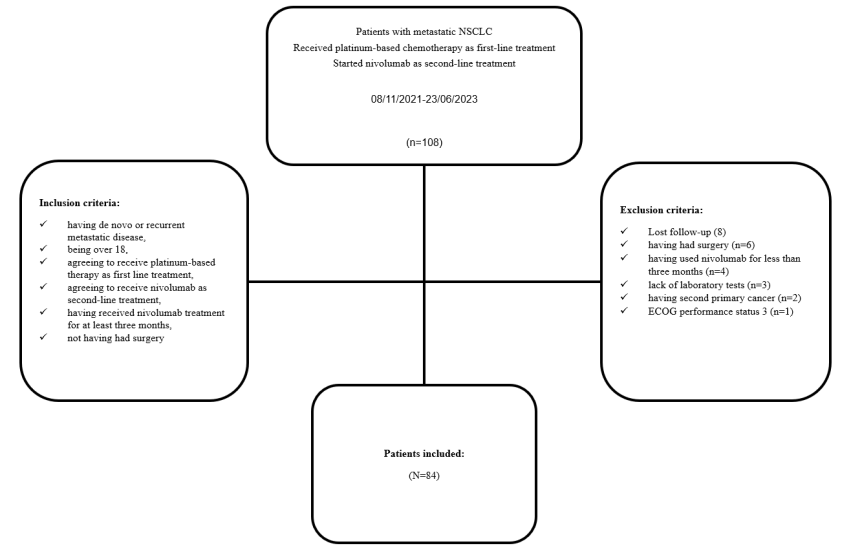
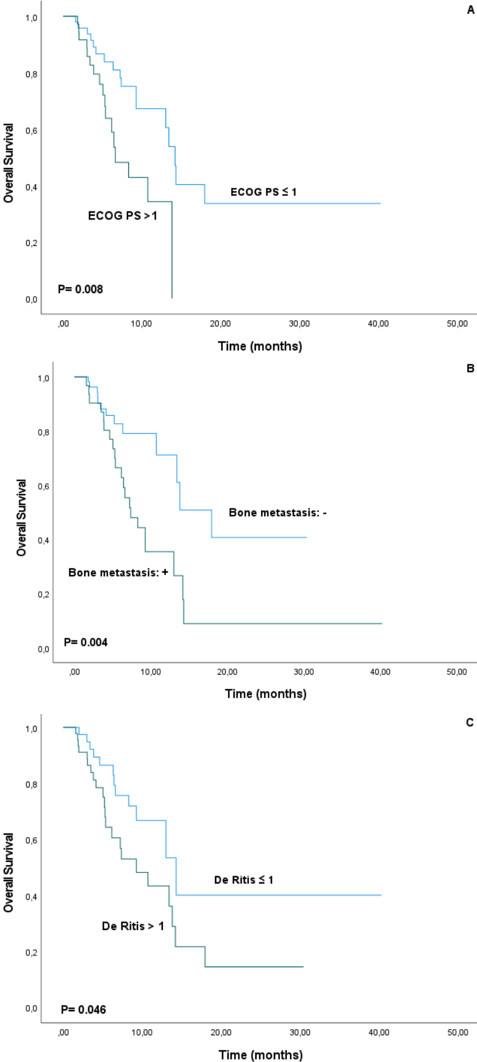
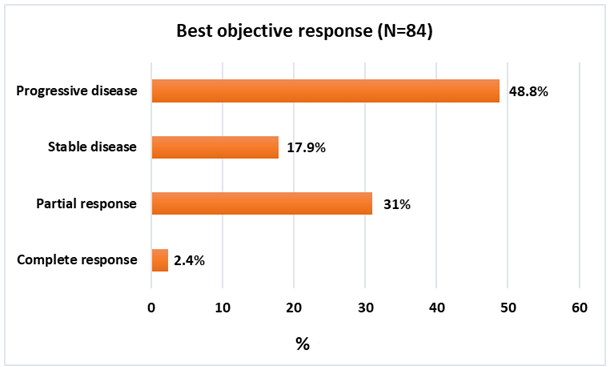
Amaç: Küçük hücreli dışı akciğer kanseri (KHDAK), sık görülen ve ölümcül seyreden bir kanser türüdür. Bu çalışmanın amacı, platin bazlı tedavi sonrası ikinci basamak tedavi olarak nivolumab kullanılan metastatik KHDAK tanılı hastalarda, klinik, laboratuvar ve sistemik inflamatuar yanıt verilerinin hastalıksız sağkalım (PFS) ve genel sağkalım (OS) üzerindeki etkilerini incelemektir. Gereçler ve Yöntemler: Çalışma retrospektif ve tek merkezli olarak yürütüldü. İkinci basamak tedavi olarak nivolumab kullanan 84 metastatik KHDAK tanılı hastaların demografik verileri, kanser tanısıyla ilişkili özellikleri ve nivolumab başlanmadan hemen öncesine ait hastaların laboratuvar parametreleri kaydedildi. C-reaktif protein/ albumin oranı (CAR), aspartat aminotransaminaz/alanin aminotransaminaz (De Ritis) oranı, Glasgow prognostik skoru (GPS), nötrofil/lenfosit oranı (NLR), platelet/ lenfosit oranı (PLR), prognostik nütrisyonel indeks (PNI) ve sistemik immün-inflamasyon indeksi (SII) parametreleri her hasta için ayrı ayrı hesaplandı. Bulgular: Tüm katılımcılar için ortalama yaş 62.08±8.43 yıl idi. Medyan PFS ve OS süreleri sırasıyla 6.4 ve 13 ay olarak belirlendi. PFS açısından yapılan tek değişkenli risk analizinde, Doğu Kooperatif Onkoloji Grubu Performans Durumu (ECOG PS) (p=0.05) ve CAR (p=0.046) PFS açısından önemli birer prognostik risk faktörü olarak belirlendi. Ancak, çok değişkenli analiz bu iki parametrenin PFS ile ilişkisini desteklemedi. OS açısından yapılan analizde ise, tek değişkenli analizde ECOG PS (p=0.01), kemik metastazı (p=0.047), CAR (p=0.019) ve De Ritis oranı (p=0.051) prognostik risk faktörleri olarak belirlendi. Çok değişkenli analizde ise, ECOG PS (HR=0.45, %95 GA 0.22-0.94, P=0.035), kemik metastazı (HR=0.38, %95 GA 0.19-0.78, P=0.008) ve De Ritis oranı (HR=0.47, %95 GA 0.23-0.96, P=0.037) bağımsız risk faktörleri olarak tespit edildi. Sonuç: Bu çalışmada, ikinci basamak tedavi olarak nivolumab kullanan metastatik KHDAK tanılı hastalarda, kötü ECOG performans durumu, kemik metastazı ve yüksek De Ritis oranı daha kısa OS süresiyle ilişkilendirilen birer bağımsız prognostik faktör olarak belirlendi. Bu faktörler, klinik pratikte hastaların prognozlarını değerlendirmede yardımcı olabilir. Anahtar Kelimeler: Akciğer kanseri, nivolumab, prognostik faktörler, CAR, De ritis oranı
Cite this Article As :
Kapagan T, Bulut N, Erdem GU. Prognostic Risk Factors Affecting Survival in Patients With Metastatic Non-Small Cell Lung Cancer
Receiving Nivolumab As Second-Line Therapy. Selcuk Med J 2025;41(1): 29-35
1. Siegel RL, Miller KD and Jemal A. Cancer statistics, 2019. CA Cancer J Clin 2019; 69: 7-34. 20190108. DOI: 10.3322/caac.21551.
2. Institute NC. The Surveillance, Epidemiology, and End Results (SEER) Program, https://seer.cancer.gov/statfacts/html/lungb.html (2017, accessed 08.09.2023).
3. Nooreldeen R and Bach H. Current and Future Development in Lung Cancer Diagnosis. Int J Mol Sci 2021; 22 20210812. DOI: 10.3390/ijms22168661.
4. Silvestri GA, Gonzalez AV, Jantz MA, et al. Methods for staging non-small cell lung cancer: Diagnosis and management of lung cancer, 3rd ed: American College of Chest Physicians evidence-based clinical practice guidelines. Chest 2013; 143: e211S-e250S. DOI: 10.1378/chest.12-2355.
5. Lahiri A, Maji A, Potdar PD, et al. Lung cancer immunotherapy: progress, pitfalls, and promises. Mol Cancer 2023; 22: 40. 20230221. DOI: 10.1186/s12943-023-01740-y.
6. Kamada T, Togashi Y, Tay C, et al. PD-1(+) regulatory T cells amplified by PD-1 blockade promote hyperprogression of cancer. Proc Natl Acad Sci U S A 2019; 116: 9999-10008. 20190426. DOI: 10.1073/pnas.1822001116.
7. Rendon A and Rayi A. Nivolumab. StatPearls. Treasure Island (FL), 2023.
8. Brahmer J, Reckamp KL, Baas P, et al. Nivolumab versus Docetaxel in Advanced Squamous-Cell Non-Small-Cell Lung Cancer. N Engl J Med 2015; 373: 123-135. 20150531. DOI: 10.1056/NEJMoa1504627.
9. Borghaei H, Paz-Ares L, Horn L, et al. Nivolumab versus Docetaxel in Advanced Nonsquamous Non-Small-Cell Lung Cancer. N Engl J Med 2015; 373: 1627-1639. 20150927. DOI: 10.1056/NEJMoa1507643.
10. Horn L, Spigel DR, Vokes EE, et al. Nivolumab Versus Docetaxel in Previously Treated Patients With Advanced Non-Small-Cell Lung Cancer: Two-Year Outcomes From Two Randomized, Open-Label, Phase III Trials (CheckMate 017 and CheckMate 057). J Clin Oncol 2017; 35: 3924-3933. 20171012. DOI: 10.1200/JCO.2017.74.3062.
11. Bernichon E, Tissot C, Bayle-Bleuez S, et al. Predictive resistance factors in lung cancer patients treated with Nivolumab. Retrospective study. Bull Cancer 2021; 108: 250-265. 20201224. DOI: 10.1016/j.bulcan.2020.10.010.
12. Sabatier R, Nicolas E, Paciencia M, et al. Nivolumab in routine practice for older patients with advanced or metastatic non-small cell lung cancer. J Geriatr Oncol 2018; 9: 494-500. 20180309. DOI: 10.1016/j.jgo.2018.02.011.
13. Muchnik E, Loh KP, Strawderman M, et al. Immune Checkpoint Inhibitors in Real-World Treatment of Older Adults with Non-Small Cell Lung Cancer. J Am Geriatr Soc 2019; 67: 905-912. 20190130. DOI: 10.1111/jgs.15750.
14. Dall'Olio FG, Maggio I, Massucci M, et al. ECOG performance status >/=2 as a prognostic factor in patients with advanced non small cell lung cancer treated with immune checkpoint inhibitors-A systematic review and meta-analysis of real world data. Lung Cancer 2020; 145: 95-104. 20200506. DOI: 10.1016/j.lungcan.2020.04.027.
15. Yang K, Li J, Bai C, et al. Efficacy of Immune Checkpoint Inhibitors in Non-small-cell Lung Cancer Patients With Different Metastatic Sites: A Systematic Review and Meta-Analysis. Front Oncol 2020; 10: 1098. 20200709. DOI: 10.3389/fonc.2020.01098.
16. Schmid S, Diem S, Li Q, et al. Organ-specific response to nivolumab in patients with non-small cell lung cancer (NSCLC). Cancer Immunol Immunother 2018; 67: 1825-1832. 20180831. DOI: 10.1007/s00262-018-2239-4.
17. Song M, Zhang Q, Song C, et al. The advanced lung cancer inflammation index is the optimal inflammatory biomarker of overall survival in patients with lung cancer. J Cachexia Sarcopenia Muscle 2022; 13: 2504-2514. 20220714. DOI: 10.1002/jcsm.13032.
18. Mandaliya H, Jones M, Oldmeadow C, et al. II. Prognostic biomarkers in stage IV non-small cell lung cancer (NSCLC): neutrophil to lymphocyte ratio (NLR), lymphocyte to monocyte ratio (LMR), platelet to lymphocyte ratio (PLR) and advanced lung cancer inflammation index (ALI). Transl Lung Cancer Res 2019; 8: 886-894. DOI: 10.21037/tlcr.2019.11.16.
19. Arakawa Y, Miyazaki K, Yoshikawa M, et al. Value of the CRP-albumin ratio in patients with resectable pancreatic cancer. J Med Invest 2021; 68: 244-255. DOI: 10.2152/jmi.68.244.
20. Bezan A, Mrsic E, Krieger D, et al. The Preoperative AST/ALT (De Ritis) Ratio Represents a Poor Prognostic Factor in a Cohort of Patients with Nonmetastatic Renal Cell Carcinoma. J Urol 2015; 194: 30-35. 20150123. DOI: 10.1016/j.juro.2015.01.083.
21. Zhang F, Ying L, Jin J, et al. The C-reactive protein/albumin ratio predicts long-term outcomes of patients with operable non-small cell lung cancer. Oncotarget 2017; 8: 8835-8842. DOI: 10.18632/oncotarget.13053.
22. Kobayashi S, Karube Y, Matsumura Y, et al. Inflammatory Risk Factors for Early Recurrence of Non-Small Cell Lung Cancer Within One Year Following Curative Resection. World J Surg 2020; 44: 3510-3521. DOI: 10.1007/s00268-020-05612-0.
23. Miyazaki T, Saji H, Nakamura H, et al. The C-reactive protein to albumin ratio is a prognostic factor for stage I non-small cell lung cancer in elderly patients: JACS1303. Surg Today 2022; 52: 1463-1471. 20220224. DOI: 10.1007/s00595-022-02485-9.
24. Karahan I and Yalcin S. Is C-Reactive Protein/Albumin Ratio of Advanced-Stage Non-small Cell Lung Cancer Patients Able to Predict Mortality in the Admission for Palliative Care? Indian J Palliat Care 2020; 26: 365-368. 20200829. DOI: 10.4103/IJPC.IJPC_218_19.
25. Frey A, Martin D, D'Cruz L, et al. C-Reactive Protein to Albumin Ratio as Prognostic Marker in Locally Advanced Non-Small Cell Lung Cancer Treated with Chemoradiotherapy. Biomedicines 2022; 10 20220303. DOI: 10.3390/biomedicines10030598.
26. Ni XF, Wu J, Ji M, et al. Effect of C-reactive protein/albumin ratio on prognosis in advanced non-small-cell lung cancer. Asia Pac J Clin Oncol 2018; 14: 402-409. 20180904. DOI: 10.1111/ajco.13055.



 Keywords