ABSTRACT
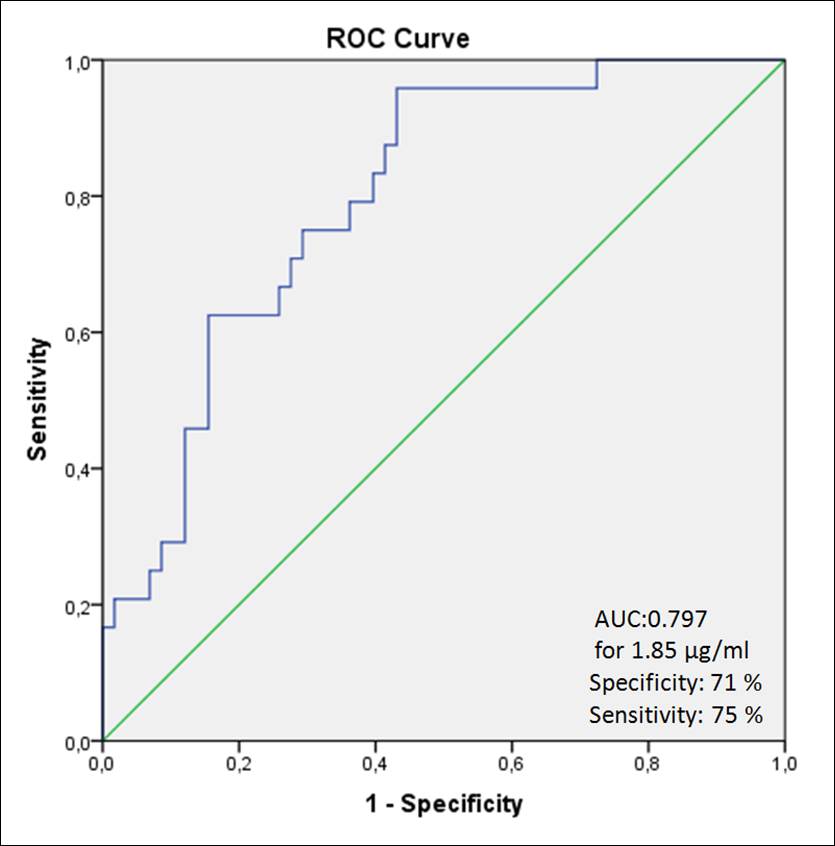
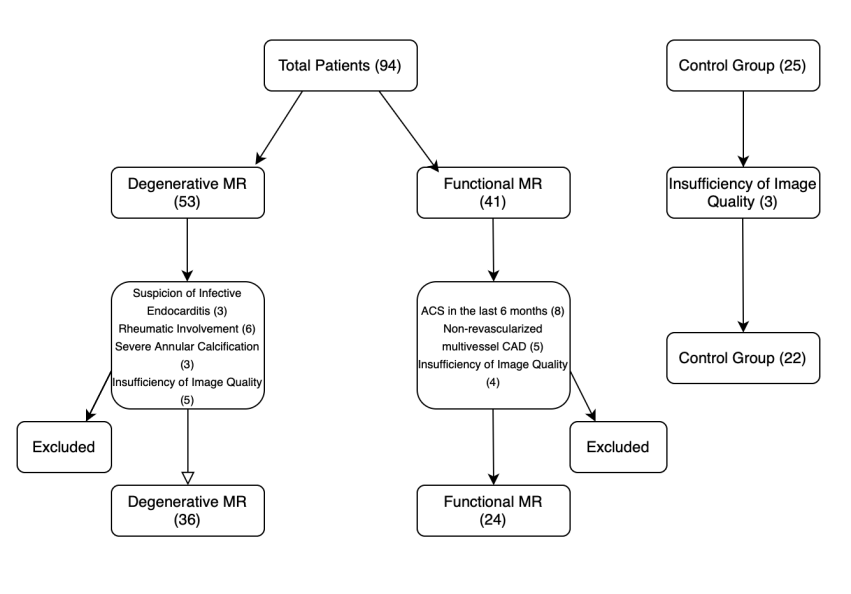
Introduction: Calprotectin is an inflammatory protein complex which is stored in the cytosol of phagocytes and released into extracellular matrix during inflammatory response. Previous studies demonstrated that levels of plasma calprotectin were higher in patients with heart failure and acute coronary syndrome. We aimed to investigate whether levels of plasma calprotectin differed between two different etiologies of mitral regurgitation; functional and degenerative mitral regurgitation. Methods: A total of 24 patients diagnosed with severe functional mitral regurgitation (FMR), 36 patients diagnosed with severe degenerative mitral regurgitation (DMR), and 22 control subjects were prospectively enrolled in this study. All participants underwent echocardiographic examinations. Plasma calprotectin levels were quantified using an enzyme-linked immunosorbent assay (ELISA) test kit. Results: Age, gender, and cardiovascular risk factors did not exhibit significant differences between the FMR, DMR, and control groups. Plasma calprotectin levels were found to be higher in the FMR group compared to both the DMR group and the control group (p <0.001 and p= 0.002, respectively). Conclusion: Our research revealed elevated plasma calprotectin levels among individuals diagnosed with severe FMR. It appears that calprotectin levels are influenced more by heart failure rather than specifically by mitral regurgitation. Keywords: Heart failure, mitral regurgitation, calprotectin, acute coronary syndrome
Cite this Article As :
Gurbuz AS, Ozturk S, Kilicgedik A, Sahin AT, Yaman A. The Role of Plasma Calprotectin Levels in Patients with Severe Mitral
Regurgitation. Selcuk Med J 2025;41(3): 152-157
1. Vahanian A, Beyersdorf F, Praz F, et al. 2021 ESC/EACTS Guidelines for the management of valvular heart disease: Developed by the Task Force for the management of valvular heart disease of the European Society of Cardiology (ESC) and the European Association for Cardio-Thoracic Surgery (EACTS). Rev Esp Cardiol (Engl Ed). 2022 Jun;75(6):524. doi: 10.1016/j.rec.2022.05.006.
2. Gruson D, Ahn SA, Rousseau MF. Biomarkers of inflammation and cardiac remodeling: the quest of relevant companions for the risk stratification of heart failure patients is still ongoing. Biochem Med (Zagreb). 2011;21(3):254-63. doi: 10.11613/bm.2011.035.
3. Hessian PA, Edgeworth J, Hogg N. MRP-8 and MRP-14, two abundant Ca(2+)-binding proteins of neutrophils and monocytes. J Leukoc Biol. 1993 Feb;53(2):197-204.
4. Volz HC, Laohachewin D, Seidel C, et al. S100A8/A9 aggravates post-ischemic heart failure through activation of RAGE-dependent NF-κB signaling. Basic Res Cardiol. 2012 Mar;107(2):250. doi: 10.1007/s00395-012-0250-z.
5. Healy AM, Pickard MD, Pradhan AD, et al. Platelet expression profiling and clinical validation of myeloid-related protein-14 as a novel determinant of cardiovascular events. Circulation. 2006 May 16;113(19):2278-84. doi: 10.1161/CIRCULATIONAHA.105.607333.
6. Altwegg LA, Neidhart M, Hersberger M, et al. Myeloid-related protein 8/14 complex is released by monocytes and granulocytes at the site of coronary occlusion: a novel, early, and sensitive marker of acute coronary syndromes. Eur Heart J. 2007 Apr;28(8):941-8. doi: 10.1093/eurheartj/ehm078.
7. Morrow DA, Wang Y, Croce K, et al. Myeloid-related protein 8/14 and the risk of cardiovascular death or myocardial infarction after an acute coronary syndrome in the Pravastatin or Atorvastatin Evaluation and Infection Therapy: Thrombolysis in Myocardial Infarction (PROVE IT-TIMI 22) trial. Am Heart J. 2008 Jan;155(1):49-55. doi: 10.1016/j.ahj.2007.08.018.
8. ensen LJ, Pedersen S, Bjerre M, et al. Plasma calprotectin predicts mortality in patients with ST segment elevation myocardial infarction treated with primary percutaneous coronary intervention. J Interv Cardiol. 2010 Apr;23(2):123-9. doi: 10.1111/j.1540-8183.2010.00532.x.
9. Jensen LJ, Kistorp C, Bjerre M, et al. Plasma calprotectin levels reflect disease severity in patients with chronic heart failure. Eur J Prev Cardiol. 2012 Oct;19(5):999-1004. doi: 10.1177/1741826711421078.
10. Ma LP, Haugen E, Ikemoto M, et al. S100A8/A9 complex as a new biomarker in prediction of mortality in elderly patients with severe heart failure. Int J Cardiol. 2012 Feb 23;155(1):26-32. doi: 10.1016/j.ijcard.2011.01.082.
11. Feigenbaum H, Armstrong WF, Ayan T. Feigenbaum’s Echocardiography. 6th ed. Philadelphia: Lippincotts Williams&Wilkins; 2005. p. 355
12. Zoghbi WA, Enriquez-Sarano M, Foster E, et al. Recommendations for evaluation of the severity of native valvular regurgitation with two-dimensional and Doppler echocardiography. J Am Soc Echocardiogr. 2003 Jul;16(7):777-802. doi: 10.1016/S0894-7317(03)00335-3.
13. Otto CM, Nishimura RA, Bonow RO, et al. 2020 ACC/AHA Guideline for the Management of Patients With Valvular Heart Disease: Executive Summary: A Report of the American College of Cardiology/American Heart Association Joint Committee on Clinical Practice Guidelines. Circulation. 2021 Feb 2;143(5):e35-e71. doi: 10.1161/CIR.0000000000000932.
14. Clavel MA, Tribouilloy C, Vanoverschelde JL, et al. Association of B-Type Natriuretic Peptide With Survival in Patients With Degenerative Mitral Regurgitation. J Am Coll Cardiol. 2016 Sep 20;68(12):1297-307. doi: 10.1016/j.jacc.2016.06.047.
15. Peng WH, Jian WX, Li HL, et al. Increased serum myeloid-related protein 8/14 level is associated with atherosclerosis in type 2 diabetic patients. Cardiovasc Diabetol. 2011 May 18;10:41. doi: 10.1186/1475-2840-10-41.
16. Bruhn LV, Lauridsen KG, Schmidt AS, et al. Elevated calprotectin in patients with atrial fibrillation with and without heart failure. Scand J Clin Lab Invest. 2017 May;77(3):210-215. doi: 10.1080/00365513.2017.1292364.
 Research Paper
 View as PDF
 Keywords
Heart Failure, Mitral Regurgitation, Calprotectin, Acute Coronary Syndrome
Keywords
Heart Failure, Mitral Regurgitation, Calprotectin, Acute Coronary Syndrome