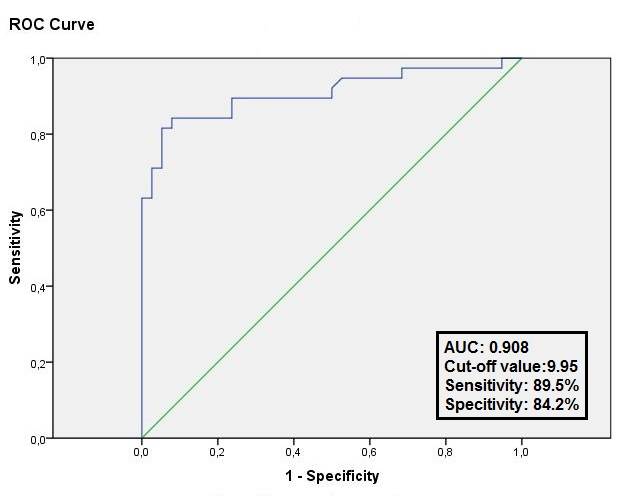
Amaç: Retinal arter oklüzyonu (RAO), oftalmolojik hastalıkların en önemli acil durumlarından biridir. Tromboembolizm RAO'nun ana etiyolojik faktörüdür. Monosit/ yüksek dansiteli lipoprotein kolesterol (HDL) oranını (MHO), çeşitli inflamatuar bozukluklarda, kardiyovasküler ve serebrovasküler hastalıklarda yeni bir prognostik biyobelirteçtir. Bu çalışmanın amacı RAO geçirmiş hastalarda MHO incelemektir. Gereç ve Yöntemler: Retrospektif olarak yapılan bu çalışmada, Ocak 2015 ile Mayıs 2019 tarihleri arasında muayene olan hastaların dosya kayıtları değerlendirildi. Çalışmaya toplam 76 hasta dahil edildi. Hastalar iki gruba ayrıldı. RAO tanısı alan 38 hasta grup 1, 38 katılımcı ise grup 2 (kontrol grubu) olarak kabul edildi. Grup 1'de 23 hasta santral retinal arter oklüzyonu (SRAO), 15 hasta ise retinal arter dal oklüzyonu (RADO) olarak sınıflandırıldı. Bulgular: Gruplar arasında cinsiyet ve yaş açısından fark yoktu (p=0,231 ve p=0,685). Gruplar kardiyovasküler hastalıklar, sistemik hipertansiyon ve diyabet açısından benzerdi (p=0,341, p=0,427, p=0,554, sırasıyla). Ortalama MHO, RAO grubunda kontrol grubuna göre anlamlı olarak daha yüksekti (14.9±5.5'e karşı 7.9±1.9, p <0.001). Alıcı çalışma karakteristikleri analizinde, MHO için eğri altındaki alan 0.908 olup MHO > 9.95 değeri % 89.5 duyarlılık ve % 84.2 özgüllük ile RAO' yu öngörmüştür. Tek değişkenli lojistik regresyonda, MHO’nın, RAO' nun bağımsız bir prediktörü olduğu görülmüştür (OR = 1.892; % 95 CI = 1.398-2.561; p <0.001). Sonuç: MHO'nın sistemik inflamasyon ve vasküler-tıkayıcı hastalıklar için basit, kullanışlı ve ucuz bir öngörücü biyobelirteç olduğu gösterilmiştir. Çalışmamız, artmış MHO'nın RAO ile önemli ölçüde ilişkili olduğunu göstermiştir. Ayrıca, MHO'nın hem SRAO hem de RADO'da daha yüksek olduğunu ortaya koymuştur. Bu nedenle MHO, riskli hastalarda RAO' nun gelişmesi açısından öngörücü bir biyobelirteç olabilir. Anahtar Kelimeler: Monosit/yüksek yoğunluklu lipoprotein kolesterol oranı, santral retinal arter oklüzyonu, retinal arter dal oklüzyonu, ateroskleroz, inflamasyon
Cite this Article As :
Mirza GD, Mirza E, Oltulu R, Satirtav Akdeniz G, Kerimoglu H, Belviranli S, Okka M. Monocyte to High-Density Lipoprotein Cholesterol
Ratio in Patients with Retinal Artery Occlusion. Selcuk Med J 2025;41(1): 7-11
1. VonGraefe A. Über embolie der arteria centralis retinae als ursache plötzlicher erblindung. Graefes Arch Ophthalmol. 1859;5:136–85.
2. Rumelt S, Dorenboim Y, Rehany U. Aggressive systematic treatment for central retinal artery occlusion. Am J Ophthalmol. 1999;128:733–738. doi:10.1016/s0002-9394(99)00359-1.
3. Park SJ, Choi NK, Seo KH, et al. Nationwide incidence of clinically diagnosed central retinal artery occlusion in Korea, 2008 to 2011. Ophthalmology. 2014;121:1933-38. doi: 10.1016/j.ophtha.2014.04.029.
4. Greven CM, Slusher MM, Weaver RG. Retinal arterial occlu¬sions in young adults. Am J Ophthalmol. 1995;120:776-83. doi: 10.1016/s0002-9394(14)72731-x.
6. Brown GC, Magargal LE, Shields JA, et al. Retinal arterial obstruction in children and young adults. Ophthalmology. 1981;88:18-25. doi: 10.1016/s0161-6420(81)35080-5.
7. Lane DA, Grant PJ. Role of hemostatic gene polymorphisms in venous and arterial thrombotic disease. Blood. 2000;95:1517-32.
8. Khyzha N, Alizada A, Wilson MD, et al. Epigenetics of Atherosclerosis: Emerging Mechanisms and Methods. Trends Mol Med. 2017;23:332-47. doi: 10.1016/j.molmed.2017.02.004.
9. Sodi A, Giambene B, Marcucci R, et al. Atherosclerotic and thrombophilic risk factors in patients with ischemic central retinal vein occlusion. Retina. 2011;31:724–29. doi:10.1097/IAE.0b013e3181eef419.
11. Tuttolomondo A, Di Raimondo D, Pecoraro R, et al. Atherosclerosis as an inflammatory disease. Curr Pharm Des 2012;18:4266-88. doi: 10.2174/138161212802481237.
12. Ancuta P, Jianbin W, Gabuzda D. CD16+ monocytes produce IL-6, CCL2 and matrix metalloproteinase-9 upon interaction with CX3CL1-expressing endothelial cells. J Leukoc Biol. 2006;80:1156–64. doi:10.1189/jlb.0206125.
13. Murphy AJ, Woollard KJ. High-density lipoprotein: a potent inhibitor of inflammation. Clin Exp Pharmacol Physiol. 2010;37:710–18. doi:10.1111/j.1440-1681.2009.05338.x.
14. Mirza E, Oltulu R, Katipoğlu Z, et al. Monocyte/HDL Ratio and Lymphocyte/Monocyte Ratio in Patients with Pseudoexfoliation Syndrome. Ocul Immunol Inflamm. 2020;28:142-46. doi: 10.1080/09273948.2018.1545913.
15. Temiz SA, Daye M. Monocyte/High-Density Lipoprotein Ratio: An Indicator of Oxidative Stress and Disease Severity in Lichen Planus Patients. Selcuk Med J 2024;40(1): 29-33. doi:10.30733/std.2023.01684.
16. Ganjali S, Gotto AM Jr, Ruscica M, et al. Monocyte-to-HDL-cholesterol ratio as a prognostic marker in cardiovascular diseases. J Cell Physiol. 2018;223:9237-46. doi: 10.1002/jcp.27028.
17. Bolayir A, Gokce SF, Cigdem B, et al. Monocyte/high-density lipoprotein ratio predicts the mortality in ischemic stroke patients. Neurol Neurochir Pol. 2018;52:150-55. doi: 10.1016/j.pjnns.2017.08.011.
18. Lusis AJ. Atherosclerosis. Nature 2000;407:233–41. doi: 10.1038/35025203.
19. Ross R. Atherosclerosis-An inflammatory disease. New Engl J Med. 1999;340: 115–26. doi: 10.1056/NEJM199901143400207.
20. Moreira DM, da Silva RL, Vieira JL, et al. Role of vascular inflammation in coronary artery disease: potential of anti-inflammatory drugs in the prevention of atherothrombosis. Inflammation and anti-inflammatory drugs in coronary artery disease. Am J Cardiovasc Drugs. 2015;15:1-11. doi: 10.1007/s40256-014-0094-z.
21. Mantovani A, Allavena P, Sica A, et al. Cancer-related inflammation. Nature 2008; 454:436-44. doi: 10.1038/nature07205.
22. Galkina E, Ley K. Immune and inflammatory mechanisms of atherosclerosis. Annu Rev Immunol. 2009;27:165–97. doi: 10.1146/annurev.immunol.021908.132620.
23. Falk E. Pathogenesis of atherosclerosis. J Am Coll Cardiol. 2006;47:C7–C12. doi: 10.1016/j.jacc.2005.09.068.
24. Aukrust P, Halvorsen B, Yndestad A, et al. Chemokines and cardiovascular risk. Arterioscler Thromb Vasc Biol. 2008;28:1909-19. doi: 10.1161/ATVBAHA.107.161240.
25. Badimon, L, Vilahur G. Thrombosis formation on atherosclerotic lesions and plaque rupture. J Intern Med. 2014;276:618–32. doi: 10.1111/joim.12296.
26. Oklu R. Thrombosis. Cardiovasc Diagn. 2017;7:S131–S133. doi: 10.21037/cdt.2017.11.08.
27. Ahuja RM, Chaturvedi S, Eliott D, et al. Mechanisms of retinal arterial occlusive disease in African American and Caucasian patients. Stroke. 1999;30:1506-09. doi: 10.1161/01.str.30.8.1506.
28. Babikian V, Wijman CA, Koleini B, et al. Retinal ischemia and embolism. Etiologies and outcomes based on a prospective study. Cerobrovasc Disc. 2001;12:108-13. doi: 10.1159/000047689.
29. Bakri SJ, Luqman A, Pathik B, et al. Is carotid ultrasound necessary in the evaluation of the asymptomatic Hollenhorst plaque? Ophthalmology. 2013;120:2747-2748.e1. doi: 10.1016/j.ophtha.2013.09.005.
30. Ovbiagele B, Nguyen-Huynh MN. Stroke epidemiology: advancing our understanding of disease mechanism and therapy. Neurotherapeutics. 2011;8:319–29.
31. Sharma S, Brown GC, Pater JL, et al. Does a Visible Retinal Embolus Increase the Likelihood of Hemodynamically Significant Carotid Artery Stenosis in Patients With Acute Retinal Arterial Occlusion? Arch Ophthalmol. 1998;116:1602-06. doi:10.1001/archopht.116.12.1602
32. Varma DD, Cugati S, Lee AW, et al. A review of central retinal artery occlusion: clinical presentation and management. Eye (Lond). 2013;27:688–97. doi:10.1038/eye.2013.25
33. Helenius J, Arsava EM, Goldstein JN, et al. Concurrent acute brain infarcts in patients with monocular visual loss. Ann Neurol. 2012;72:286–93. doi: 10.1002/ana.23597.
34. Lee J, Kim SW, Lee SC, et al. Co-occurrence of acute retinal artery occlusion and acute ischemic stroke: diffusion-weighted magnetic resonance imaging study. Am J Ophthalmol. 2014;157:1231–38. doi: 10.1016/j.ajo.2014.01.033.
35. Avery MB, Magal I, Kherani A, et al. Risk of Stroke in Patients With Ocular Arterial Occlusive Disorders: A Retrospective Canadian Study. J Am Heart Assoc. ;8(3):e010509. doi:10.1161/JAHA.118.010509
36. Park SJ, Choi NK, Yang BR, et al. Risk and risk periods for stroke and acute myocardial infarction in patients with central retinal artery occlusion. Ophthalmology. 2015;122:2336–43. doi: 10.1016/j.ophtha.2015.07.018.
37. Korkmaz A, Demir M, Unal S, et al. Monocyte-to-high density lipoprotein ratio (MHR) can predict the significance of angiographically intermediate coronary lesions. Int J Cardiovasc Acad. 2017;3:16-20. doi.org/10.1016/j.ijcac.2017.05.008
38. Cetin MS, Ozcan Cetin EH, Kalender E, et al. Monocyte to HDL Cholesterol Ratio Predicts Coronary Artery Disease Severity and Future Major Cardiovascular Adverse Events in Acute Coronary Syndrome. Heart Lung Circ. 2016;25:1077-86. doi: 10.1016/j.hlc.2016.02.023.



 Keywords