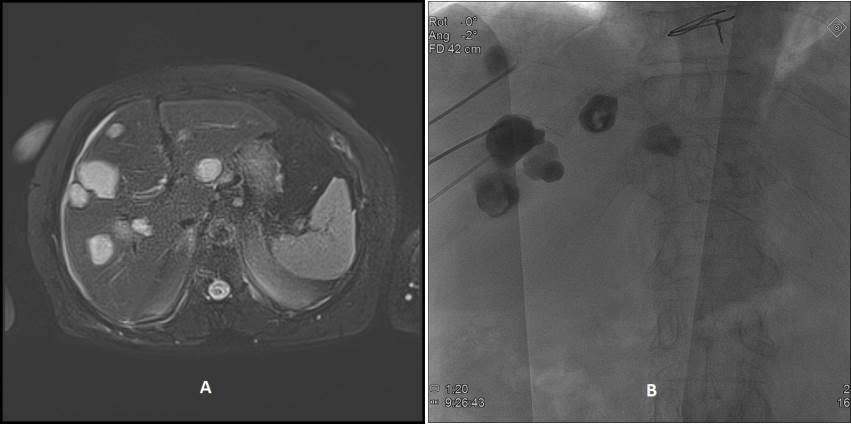
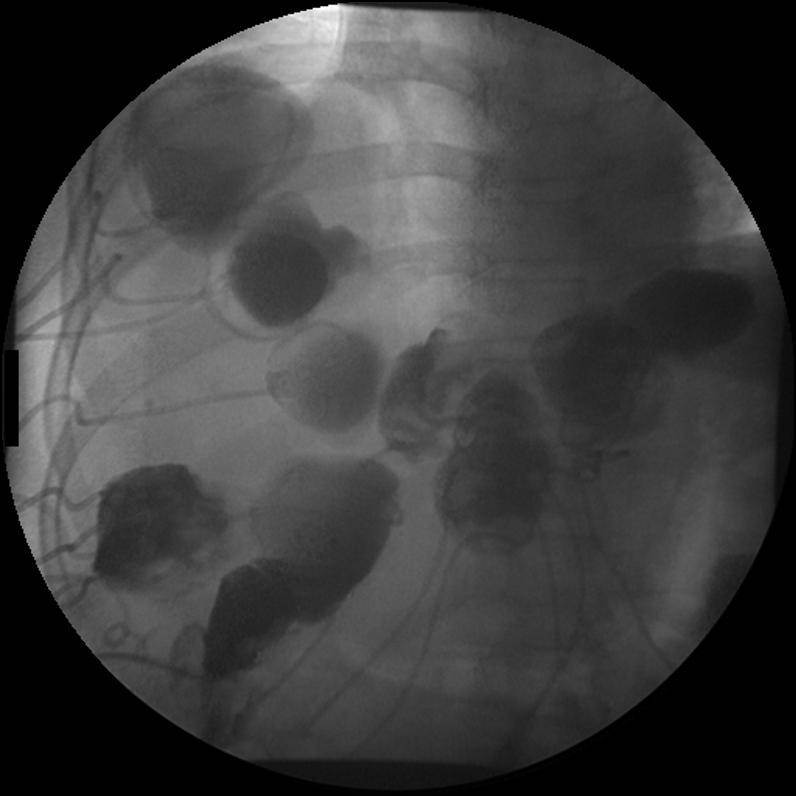
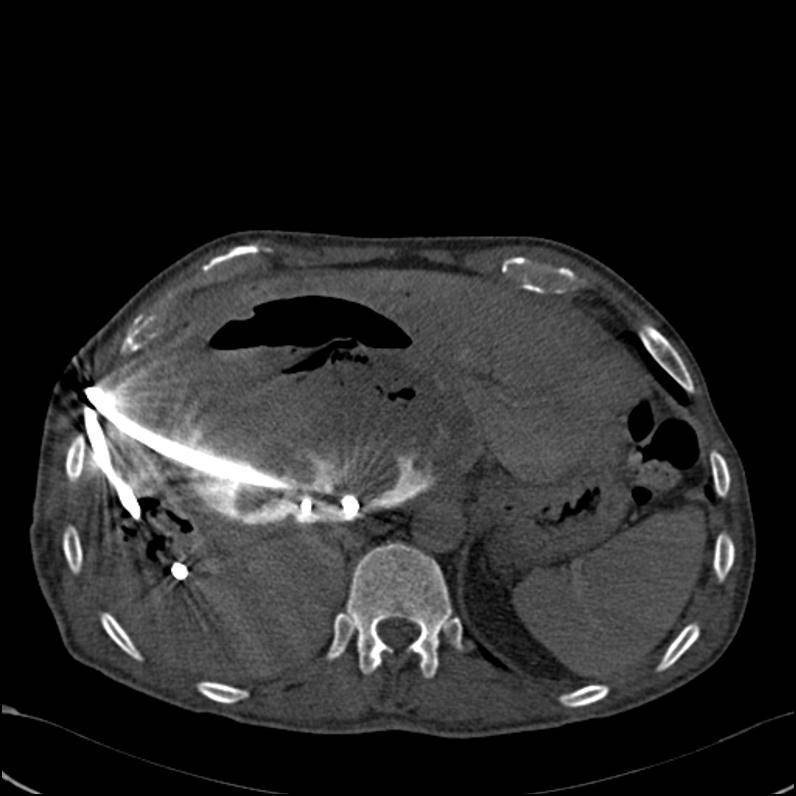
Objective: Hydatid cysts are primarily treated surgically, and surgical treatment is associated with high morbidity, mortality, and prolonged hospitalization. However, over the last two decades, minimally invasive percutaneous treatments that provide favorable outcomes with low morbidity and mortality have been developed. In this study, we aimed to demonstrate a percutaneous treatment for disseminated liver hydatid cysts (CE) and to evaluate the therapeutic success rates and the advantages of alcohol as a scolicidal and sclerosing agent. Materials and Methods: We retrospectively investigated 132 percutaneously treated CEs in 23 patients who were admitted with disseminated hepatic and extrahepatic CE between September 2016 and December 2018, each of whom had fewer than three cysts. CE type 1 (Gharbi type 1) and CE type 3a (Gharbi type 2) hydatid cysts measuring 6 cm were treated with catheterization (SPC). All CE cysts classified as types 2 and 3b (the latter corresponding to Gharbi type 3) were treated using the modified catheterization technique (MoCAT). Results: All 132 lesions in 23 patients were successfully treated percutaneously. The following observations were recorded: pseudotumor appearance in 80 cysts (60.61%); more than 50% reduction in cystic volume in 33 cysts (25%); thickening of the cyst wall, irregular cyst contours, and membrane detachment (numbers were not reported); less than 50% reduction in cystic volume in 10 cysts (7.58%); and complete disappearance in 9 cysts (6.82%). Conclusion: Percutaneous treatments are safe and effective for patients with disseminated hepatic and extrahepatic hydatid disease and should be considered first line therapy because surgical interventions are associated with high morbidity. When appropriate safety limits and precautions are observed, alcohol appears to be a safe and effective treatment for disseminated disease, demonstrating both scolicidal and sclerosing properties. Keywords: Disseminated hydatid cysts, ethyl alcohol injection, extrahepatic hydatid cysts, interventional radiology, percutaneous cyst treatment
Cite this Article As :
Bakdik S, Keskin M, Turgut B. Successfully Percutaneous Treatment with Ethyl Alcohol in Multiple Hepatic and Extrahepatic Hydatid Cysts; Long Term
Outcomes. Selcuk Med J 2026;42(2): 127-134
1. Pakala T, Molina M, Wu GY. Hepatic Echinococcal Cysts: A Review. J Clin Transl Hepatol. 2016;4(1):39-46. doi:10.14218/JCTH.2015.00036
2. Lianos GD, Lazaros A, Vlachos K, et al. Unusual locations of hydatid disease: a 33 year's experience analysis on 233 patients. Updates Surg. 2015;67(3):279-82. doi:10.1007/s13304-015-0291-6
3. Giorgio A, de Stefano G, Di Sarno A, et al. Clinical and sonographic management of viable hydatid liver cysts. J Ultrasound. 2008;11(3):107-12. doi:10.1016/j.jus.2008.05.004
4. Sozuer E, Akyuz M, Akbulut S. Open surgery for hepatic hydatid disease. Int Surg. 2014;99(6):764-69. doi:10.9738/INTSURG-D-14-00069.1
5. Fisichella PM, Donaldson K, Helton WS. Hepatic and splenic hydatidosis managed with percutaneous aspiration, injection, and reaspiration (PAIR) of the hepatic cyst and laparoscopic splenectomy. J Gastrointest Surg. 2008;12(9):1615-17. doi:10.1007/s11605-007-0419-1
6. Paksoy Y, Odev K, Sahin M, et al. Percutaneous treatment of liver hydatid cysts: comparison of direct injection of albendazole and hypertonic saline solution. AJR Am J Roentgenol. 2005;185(3):727-34. doi:10.2214/ajr.185.3.01850727
7. Akhan O, Yildiz AE, Akinci D, et al. Is the adjuvant albendazole treatment really needed with PAIR in the management of liver hydatid cysts? A prospective, randomized trial with short-term follow-up results. Cardiovasc Intervent Radiol. 2014;37(6):1568-74. doi:10.1007/s00270-014-0840-2
8. Akhan O, Ozmen MN. Percutaneous treatment of liver hydatid cysts. Eur J Radiol. 1999;32(1):76-85. doi:10.1016/s0720-048x(99)00116-3
9. Giorgio A, de Stefano G, Esposito V, et al. Long-term results of percutaneous treatment of hydatid liver cysts: a single center 17 years experience. Infection. 2008;36(3):256-61. doi:10.1007/s15010-007-7103-y
10. Kahriman G, Ozcan N, Donmez H. Hydatid cysts of the liver in children: percutaneous treatment with ultrasound follow-up. Pediatr Radiol. 2011;41(7):890-94. doi:10.1007/s00247-011-2088-1
11. Nayman A, Guler I, Keskin S, et al. A novel modified PAIR technique using a trocar catheter for percutaneous treatment of liver hydatid cysts: a six-year experience. Diagn Interv Radiol. 2016;22(1):47-51. doi:10.5152/dir.2015.15011
12. Arslan S, Bakdik S, Oncu F, et al. Successful percutaneous treatment of extrahepatic cystic echinococcosis through PAIR and single puncture catheter techniques. Jpn J Radiol. 2017;35(6):296-02. doi:10.1007/s11604-017-0633-z
13. Kabaalioğlu A, Ceken K, Alimoglu E, et al. Percutaneous imaging-guided treatment of hydatid liver cysts: do long-term results make it a first choice?. Eur J Radiol. 2006;59(1):65-73. doi:10.1016/j.ejrad.2006.01.014
14. Velasco-Tirado V, Alonso-Sardón M, Lopez-Bernus A, et al. Medical treatment of cystic echinococcosis: systematic review and meta-analysis. BMC Infect Dis. 2018 Jul 5;18(1):306. doi: 10.1186/s12879-018-3201-y.
15 Mohamed AE, Yasawy MI, Al Karawi MA. Combined albendazole and praziquantel versus albendazole alone in the treatment of hydatid disease. Hepatogastroenterology. 1998 Sep-Oct;45(23):1690-94. PMID: 9840130.
16. Cobo F, Yarnoz C, Sesma B, et al. Albendazole plus praziquantel versus albendazole alone as a pre-operative treatment in intra-abdominal hydatisosis caused by Echinococcus granulosus. Trop Med Int Health. 1998;3(6):462-66. doi:10.1046/j.1365-3156.1998.00257.x
17. Anand S, Rajagopalan S, Mohan R. Retraction notice to "Management of liver hydatid cysts - Current perspectives" Med J Armed Forces India. 2017;73(1):104. doi:10.1016/j.mjafi.2016.12.011
18. Gomez I Gavara C, López-Andújar R, Belda Ibáñez T, et al. Review of the treatment of liver hydatid cysts. World J Gastroenterol. 2015;21(1):124-31. doi:10.3748/wjg.v21.i1.124
19. Gharbi HA, Hassine W, Brauner MW, et al. Ultrasound examination of the hydatic liver. Radiology. 1981;139(2):459-63. doi:10.1148/radiology.139.2.7220891
20. WHO Informal Working Group. International classification of ultrasound images in cystic echinococcosis for application in clinical and field epidemiological settings. Acta Trop. 2003;85(2):253-61. doi:10.1016/s0001-706x(02)00223-1
21. Giorgio A, Di Sarno A, de Stefano G, et al. Sonography and clinical outcome of viable hydatid liver cysts treated with double percutaneous aspiration and ethanol injection as first-line therapy: efficacy and long-term follow-up. AJR Am J Roentgenol. 2009;193(3): W186-W192. doi:10.2214/AJR.08.1518
22. Tüzün M, Hekimoğlu B. Pictorial essay. Various locations of cystic and alveolar hydatid disease: CT appearances. J Comput Assist Tomogr. 2001;25(1):81-87. doi:10.1097/00004728-200101000-00014
23. Stojkovic M, Rosenberger K, Kauczor HU, et al. Diagnosing and staging of cystic echinococcosis: how do CT and MRI perform in comparison to ultrasound? PLoS Negl Trop Dis. 2012;6(10):e1880. doi:10.1371/journal.pntd.0001880
24. Marani SA, Canossi GC, Nicoli FA, et al. Hydatid disease: MR imaging study. Radiology. 1990;175(3):701-06. doi:10.1148/radiology.175.3.2343117
25. Gupta N, Javed A, Puri S, et al. Hepatic hydatid: PAIR, drain or resect? J Gastrointest Surg. 2011;15(10):1829-36. doi:10.1007/s11605-011-1649-9
26. Citgez B, Battal M, Cipe G, et al. Feasibility and safety of laparoscopic hydatid surgery: a systematic review. Hepatogastroenterology. 2013;60(124):784-88. doi:10.5754/hge12527
27. Yagci G, Ustunsoz B, Kaymakcioglu N, et al. Results of surgical, laparoscopic, and percutaneous treatment for hydatid disease of the liver: 10 years experience with 355 patients. World J Surg. 2005;29(12):1670-79. doi:10.1007/s00268-005-0058-1
28. Castellano G, Moreno-Sanchez D, Gutierrez J, et al. Caustic sclerosing cholangitis. Report of four cases and a cumulative review of the literature. Hepatogastroenterology. 1994;41(5):458-70.
29. Filice C, Pirola F, Brunetti E, et al. A new therapeutic approach for hydatid liver cysts. Aspiration and alcohol injection under sonographic guidance. Gastroenterology. 1990;98(5 Pt 1):1366-68. doi:10.1016/0016-5085(90)90358-8
30. Bakdik S, Arslan S, Oncu F, et al. Percutaneous treatment of hepatic cystic echinococcosis: the success of alcohol as a single endocavitary agent in PAIR, catheterization, and modified catheterization techniques. Radiol Med. 2018;123(2):153-60. doi:10.1007/s11547-017-0820-0
31. Jang SY, Park SY, Tak WY, et al. Long-term follow-up of large symptomatic hepatic cysts treated by percutaneous ethanol sclerotherapy. Acta Radiol. 2016;57(10):1205-09. doi:10.1177/0284185115626476
32. Cheng D, Amin P, Ha TV. Percutaneous sclerotherapy of cystic lesions. Semin Intervent Radiol. 2012;29(4):295-00. doi:10.1055/s-0032-1330063
33. Sönmez K, Karabulut R, Türkyilmaz Z, et al. Clear cystic fluid in hepatic hydatidosis does not rule out communication between cysts and the biliary system. Adv Ther. 2007;24(2):291-95. doi:10.1007/BF02849896
34. Siracusano A, Teggi A, Ortona E. Human cystic echinococcosis: old problems and new perspectives. Interdiscip Perspect Infect Dis. 2009;2009:474368. doi:10.1155/2009/474368
35. Corona M, Cannavale A, Bruni A, et al. Case report: Percutaneous treatment of multiple honeycomb-like liver hydatid cysts (type III CE2, according to WHO classification). Indian J Radiol Imaging. 2012;22(1):23-26. doi:10.4103/0971-3026.95399



 Keywords