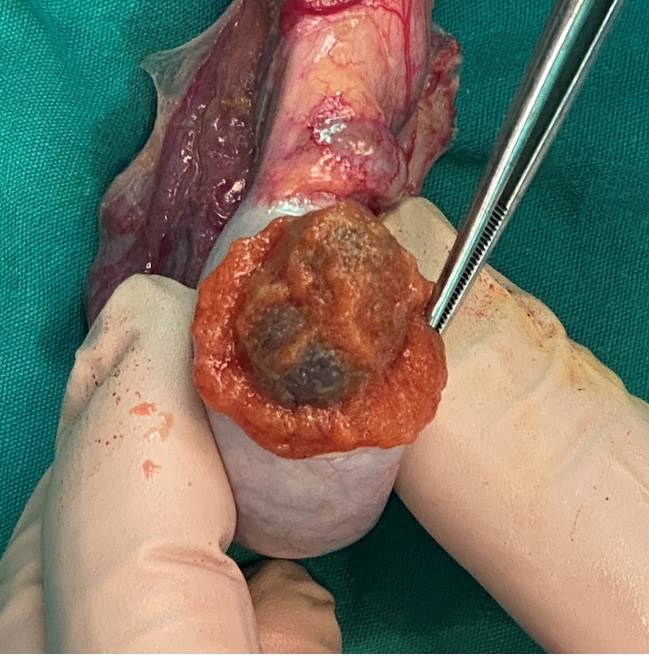
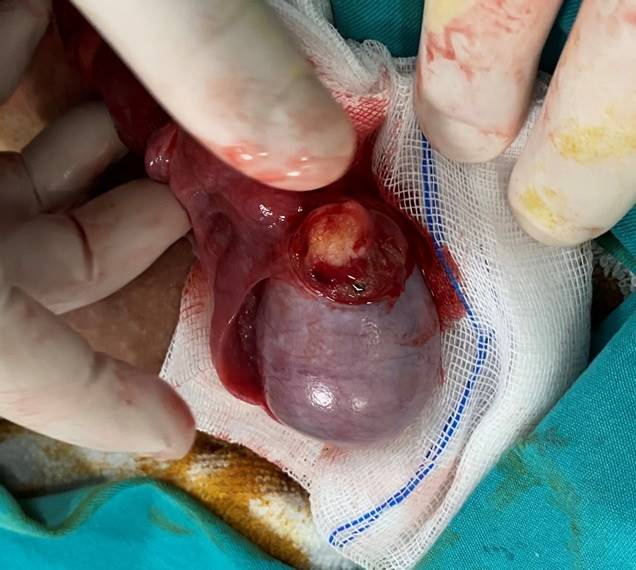
ABSTRACT
Objective: To evaluate our testis-sparing surgery ( TSS) experiences in our clinic and outline its oncological and functional outcomes. Materials and Methods: Patients who underwent TSS due to testicular mass in our clinic between 2008 and 2023 were included in the study. Patients with a mass in solitary testis, bilateral testicular mass as well as patients with a normal contralateral testis and a mass of less than 2 cm or less than 30% of the testicular volume were included in the study. Patient demographics, tumor characteristics, and follow-up data were collected and analyzed statistically. Results: A total of 26 patients who underwent TSS were evaluated. Germ Cell Tumor (GCT ) was detected in 9 patients, and benign testicular mass was detected in 17 patients. The mean patient age was 25±6.1 (18-69) years. The mean tumor size was 12.9±4.4 (range 7-24) mm in all patients. Patients with GCTs were followed up for a mean of 21.8±7.8 (10-36) months. Local recurrence was observed in one patient during follow-up, and radical orchiectomy was performed. No recurrence or metastasis was observed in other patients during the follow-up period. Benign lesions were followed up for 21.5±9.3 (10-38) months. Recurrence was not observed. There was no significant decrease in testosterone levels after surgery (p=0.3). Conclusions: Excellent outcomes for benign tumors using TSS were obtained in the present study. TSS could be suggested as a safe and effective treatment option in patients with germ cell tumors, as in the present study. However, more data regarding the potential risks and benefits of TSS with a larger patient series is needed. Keywords: Bilateral testicular tumor, germ cell tumor, solitary testis, testis sparing surgery
Cite this Article As :
Göger YE, Kilinc MT, Izaddin Alalam HN, Cavdar OF, Piskin MM. Testicular Sparing Surgery in Small Testicular Lesions: Functional and
Oncological Outcomes. Selcuk Med J 2024;40(4): 159-165
1. Manecksha, R.P. and J.M. Fitzpatrick, Epidemiology of testicular cancer. BJU international, 2009. 104(9b): p. 1329-1333.
2. Gilligan, T., W Lin D, Aggarwal R, et al., Testicular cancer, version 2.2020, NCCN clinical practice guidelines in oncology. Journal of the National Comprehensive Cancer Network, 2019. 17(12): p. 1529-1554.
3. Dieckmann, K.-P., U. Frey, and G. Lock, Contemporary diagnostic work-up of testicular germ cell tumours. Nature Reviews Urology, 2013. 10(12): p. 703.
4. Borghesi, M., Brunocilla E, Schiavina R, et al., Role of testis-sparing surgery in the conservative management of small testicular masses: Oncological and functional perspectives. Actas Urológicas Españolas (English Edition), 2015. 39(1): p. 57-62.
5. Gentile, G., Brunocilla E, Franceschelli A, et al., Can testis-sparing surgery for small testicular masses be considered a valid alternative to radical orchiectomy? A prospective single-center study. Clinical genitourinary cancer, 2013. 11(4): p. 522-526.
6. Shilo, Y., Zisman A, Raz O, et al. Testicular sparing surgery for small masses. in Urologic Oncology: Seminars and Original Investigations. 2012. Elsevier.
7. Albers, P., Albrecht W, Algaba F, et al., Guidelines on testicular cancer: 2015 update. European urology, 2015. 68(6): p. 1054-1068.
8. Cvancarova, M., Samuelsen O, Magelssen H, et al., Reproduction rates after cancer treatment: experience from the Norwegian radium hospital. Journal of Clinical Oncology, 2009. 27(3): p. 334-343.
9. Scandura, G., Verrill C, Protheroe A, et al., Incidentally detected testicular lesions< 10 mm in diameter: can orchidectomy be avoided? BJU international, 2018. 121(4): p. 575-582.
10. Stephenson, A., Eggener S, Bass E, et al., Diagnosis and treatment of early stage testicular cancer: AUA guideline. The Journal of urology, 2019. 202(2): p. 272-281.
11. Bojanic, N., Bumbasirevic U, Bojanic G, et al., Testis sparing surgery for treatment of small testicular lesions: Is it feasible even in germ cell tumors? Journal of Surgical Oncology, 2017. 115(3): p. 287-290.
12. Bojanic, N., Bumbasirevic U, Vukovic I, et al., Testis sparing surgery in the treatment of bilateral testicular germ cell tumors and solitary testicle tumors: a single institution experience. Journal of surgical oncology, 2015. 111(2): p. 226-230.
13. Heidenreich, A., Weissbach l, Höltl LW, et al., Organ sparing surgery for malignant germ cell tumor of the testis. The Journal of urology, 2001. 166(6): p. 2161-2165.
14. Nason, G., Aditya I, Leao R, et al. Partial orchiectomy: The Princess Margaret cancer centre experience. in Urologic Oncology: Seminars and Original Investigations. 2020. Elsevier.
15. Galosi, A.B., Fulvi P, Fabiani A, et al., Testicular sparing surgery in small testis masses: A multinstitutional experience. Archivio Italiano di Urologia e Andrologia, 2016. 88(4): p. 320-324.
16. Giannarini, G., Dieckmann K-P, Albers P, et al., Organ-sparing surgery for adult testicular tumours: a systematic review of the literature. European urology, 2010. 57(5): p. 780-790.
17. Ates, F., Malkoc E, Zor M, et al., Testis-sparing surgery in small testicular masses not suspected to be malignant. Clinical genitourinary cancer, 2016. 14(1): p. e49-e53.
18. Keske, M., Canda AE, Yalcin S, et al., Is testis-sparing surgery safe in small testicular masses? Results of a multicentre study. Canadian Urological Association Journal, 2017. 11(3-4): p. E100.
19. Park, S.B., Lee WC, Kim JK, et al., Imaging features of benign solid testicular and paratesticular lesions. European radiology, 2011. 21(10): p. 2226.
20. Silverio, P.C., Schoofs F, Iselin CE, et al., Fourteen-year experience with the intraoperative frozen section examination of testicular lesion in a tertiary university center. Annals of Diagnostic Pathology, 2015. 19(3): p. 99-102.
21. Leroy, X., Rigot JM, Aubert S, et al., Value of frozen section examination for the management of nonpalpable incidental testicular tumors. European urology, 2003. 44(4): p. 458-460.
22. Liu, B., Su h, Cheng G, et al., Experiences and outcomes of organ-sparing surgery for testicular tumour with benign tendency. Canadian Urological Association Journal, 2015. 9(11-12): p. E785.
23. Connolly SS, D'Arcy FT, Bredin HC, Callaghan J, Corcoran MO. Value of frozen section analysis with suspected testicular malignancy. Urology. 2006; 67: 162-165.
24. Matei DV, Vartolomei MD, Renne G, et al. Reliability of Frozen Section Examination in a Large Cohort of Testicular Masses: What Did We Learn? Clin Genitourin Cancer. 2017; 15: e689-696.
25. Rossen, P., Pedersen AF, Zachariae R, et al., Sexuality and body image in long-term survivors of testicular cancer. European journal of cancer, 2012. 48(4): p. 571-578.
26. Skaali, T., Fossa SD, Bremnes R, et al., Fear of recurrence in long‐term testicular cancer survivors. Psycho‐Oncology: Journal of the Psychological, Social and Behavioral Dimensions of Cancer, 2009. 18(6): p. 580-588.
27. Laclergerie F. Mouillet G, Frontczak A, et al., Testicle-sparing surgery versus radical orchiectomy in the management of Leydig cell tumors: results from a multicenter study. World journal of urology, 2018. 36(3): p. 427-433.
28. Djaladat H., Organ-sparing surgery for testicular tumours. Current opinion in urology, 2015. 25(2): p. 116-120.
29. Ferretti L., Sargos P, Gross-Goupil M, et al., Testicular‐sparing surgery for bilateral or monorchide testicular tumours: a multicenter study of long‐term oncological and functional results. BJU international, 2014. 114(6): p. 860-864.
30. Berkmen F. Bılateral Testıkuler Germ Hucrelı Tumorler, Araştırma makalesi,



 Keywords