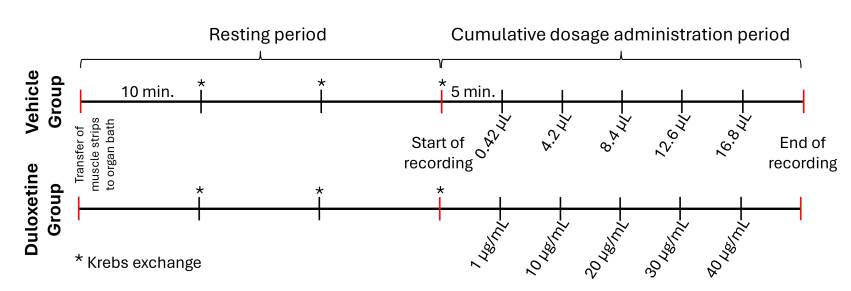
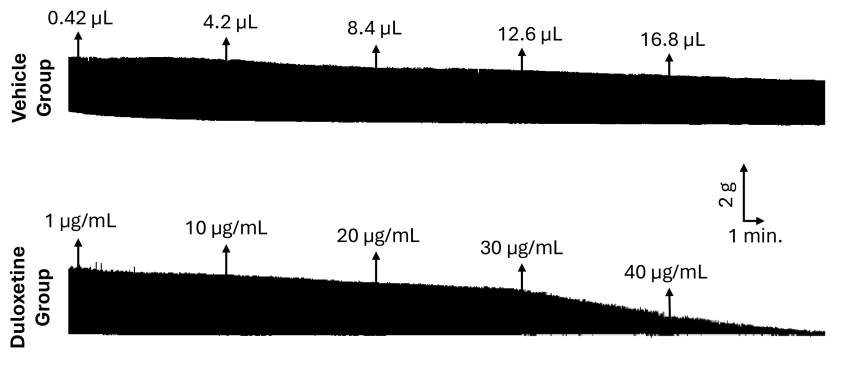
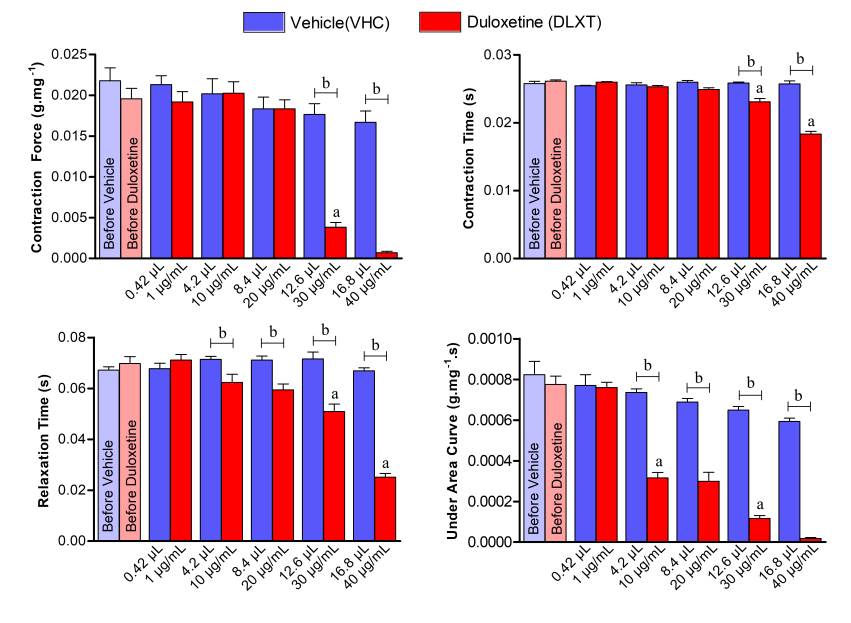
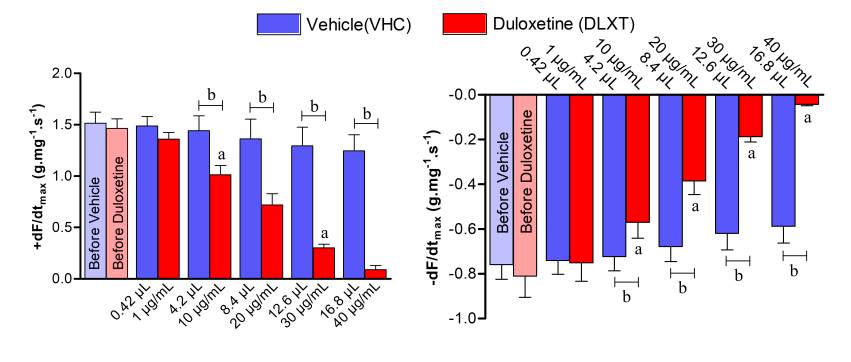
ABSTRACT Aim: Duloxetine is an active ingredient prescribed to patients for a wide range of conditions. Although the information with purchased drugs containing duloxetine mention various side effects on different muscle tissues, there is limited research available on the potential effects on the skeletal muscle of the diaphragm, which plays an important role in respiratory functions. In this study, the potential effects of different doses of duloxetine on in vitro mechanical activities of the diaphragm muscle were examined. Additionally, the impact of these activities on the diaphragm muscle was discussed in terms of the respiratory functions of patients prescribed duloxetine. Materials and Methods: Sixteen adult Wistar-Albino rats, each 24 weeks old, were randomly divided into two groups: duloxetine(DLXT ) and vehicle( VHC). Diaphragm muscles were isolated from rats in both groups under anesthesia and transferred to a 5mL volume isolated organ bath, in which muscle strips were adjusted to a 2g preload. For DLXT group, the diaphragm muscles were cumulatively treated with duloxetine at concentrations of 1, 10, 20, 30, and 40 µg/mL, while VHC group received the same volume of the vehicle. Contractions were induced using square pulses of 0.5 Hz frequency and 1 ms duration. Results: From the contraction curves, data was obtained on contraction force(g.mg-1), contraction time(s), relaxation time(s), under area curve(g.mg-1.s), +dF/dtmax(g. mg-1·s-1), and -dF/dtmax(g.mg-1.s-1). In DLXT group, relaxation time, area under the curve, +dF/dtmax, and -dF/dtmax parameters showed significant differences compared to the VHC group with the application of 10 µg/mL duloxetine. Similar difference was observed in contraction force and contraction time with the application of 30 µg/mL duloxetine. Conclusions: The effects of duloxetine on diaphragm muscle contraction parameters observed in this study suggest that duloxetine may adversely affect respiratory functions. It is therefore important that the respiratory functions in patients prescribed duloxetine be closely monitored. Keywords: Antidepressants, diaphragm, duloxetine, isometric contraction, respiratory
Cite this Article As :
Akkoca A, Sen A, Kutlu S. The Dose-Dependent Effects of Duloxetine on the Mechanical Muscle Activities of Rat Diaphragms. Selcuk
Med J 2024;40(3):19-23. DOI:http:/dx.doi.org/10.30733/std.2024.01753
1. Knadler MP, Lobo E, Chappell J, et al. Duloxetine: clinical pharmacokinetics and drug interactions. Clinical pharmacokinetics 2011;50(5):281-94.
2. Finsterer J, Habitzl W. Incapacitating, generalised myalgias and muscle stiffness under duloxetine and aripiprazole. International journal of clinical practice 2020;74(6):e13487.
3. Merrell AJ, Kardon G. Development of the diaphragm, a skeletal muscle essential for mammalian respiration. The FEBS journal 2013;280(17):4026-35.
4. Leander M, Lampa E, Rask-Andersen A, et al. Impact of anxiety and depression on respiratory symptoms. Respiratory medicine 2014;108(11):1594-600.
5. Wang G, Zhou T, Wang L, et al. Relationship between current psychological symptoms and future risk of asthma outcomes: a 12-month prospective cohort study. The Journal of asthma: official journal of the Association for the Care of Asthma 2011;48(10):1041-50.
6. Park Y, Jung JY, Kim YS, et al. Relationship between depression and lung function in the general population in Korea: a retrospective cross-sectional study. International journal of chronic obstructive pulmonary disease 2018;13:2207-13.
7. Zhang L, Jiang F, Xie Y, et al. Diabetic endothelial microangiopathy and pulmonary dysfunction. Frontiers in endocrinology 2023;14:1073878.
8. Solak Gormus ZI, Eker CB, Solak H, et al. Does Sertraline Affect Contraction in Endothelium Damaged Aorta?. Selcuk Medical Journal 2024;40(1):8-15.
9. Akkoca A, Celen MC, Tuncer S, et al. Abdominal Ischemia-Reperfusion Induced Cardiac Dysfunction Can Be Prevented by MitoTEMPO. Journal of Investigative Surgery 2022;35(3):577-83.
10. Akkoca A, Tuncer S, Çelen MC, et al. The Effect of MitoTEMPO on Rat Diaphragm Muscle Contraction Parameters in an Experimental Diabetes Model Induced with Streptozotocin. European Journal of Therapeutics 2023;29(4):820-8.
11. Thomas J, Khanam R, Vohora D. A validated HPLC-UV method and optimization of sample preparation technique for norepinephrine and serotonin in mouse brain. Pharm Biol 2015;53(10):1539-44.
12. de Liyis BG, Sutedja JC, Tjandra DC, et al. Serotonin norepinephrine reuptake inhibitors in managing neuropathic pain following spinal and non-spinal surgery: A systematic review and meta-analysis of randomized controlled trials. Clin Neurol Neurosurg 2024;239:108223.
13. Wernicke JF, Gahimer J, Yalcin I, et al. Safety and adverse event profile of duloxetine. Expert Opin Drug Saf 2005;4(6):987-93.
14. Bitter I, Filipovits D, Czobor P. Adverse reactions to duloxetine in depression. Expert Opin Drug Saf 2011;10(6):839-50.
15. Müller N, Schennach R, Riedel M, et al. Duloxetine in the treatment of major psychiatric and neuropathic disorders. Expert Rev Neurother 2008;8(4):527-36.
16. Polychroniou PE, Mayberg HS, Craighead WE, et al. Temporal Profiles and Dose-Responsiveness of Side Effects with Escitalopram and Duloxetine in Treatment-Naïve Depressed Adults. Behav Sci (Basel) 2018;8(7):1-13.
17. Thase ME, Tran PV, Wiltse C, et al. Cardiovascular profile of duloxetine, a dual reuptake inhibitor of serotonin and norepinephrine. J Clin Psychopharmacol 2005;25(2):132-40.
18. Eyal R, Yaeger D. Poor neonatal adaptation after in utero exposure to duloxetine. Am J Psychiatry 2008;165(5):651.
19. Şahan E, Parlakkaya Yıldız FB. Duloxetine Induced Hyponatremia. Duloksetine Bağlı Hiponatremi. Turk Psikiyatri Derg 2019;30(4):287-9.
20. Wang SY, Calderon J, Kuo Wang G. Block of neuronal Na+ channels by antidepressant duloxetine in a state-dependent manner. Anesthesiology 2010;113(3):655-65.
21. van Lunteren E, Moyer M, Dick TE. Modulation of diaphragm action potentials by K(+) channel blockers. Respir Physiol 2001;124(3):217-30.
22. van Lunteren E, Moyer M. Wheel-running exercise alters rat diaphragm action potentials and their regulation by K+ channels. J Appl Physiol 2003;95(2):602-10.
 Research Paper
 View as PDF
 Keywords
Antidepressants, Diaphragm, Duloxetine, Isometric Contraction, Respiratory