ABSTRACT
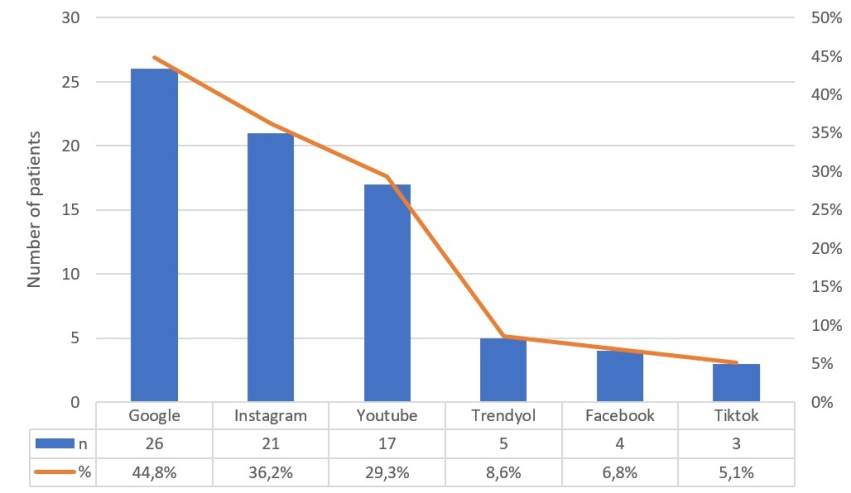
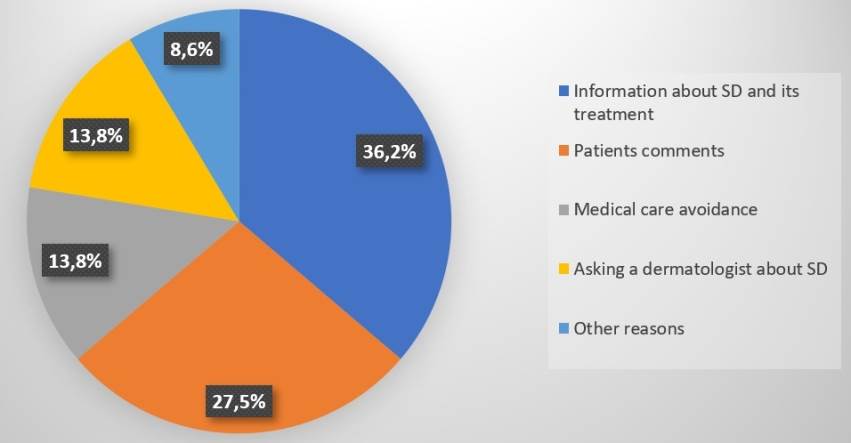
Objectives: This study aimed to investigate the internet and social media usage habits of seborrheic dermatitis patients in relation to their diseases, the underlying reasons for internet and SM usage, as well as the treatment advice they used. Materials and Methods: Patients with seborrheic dermatitis were asked to answer a questionnaire consisting of eight questions and provide their age, gender, and disease duration. The seborrheic dermatitis area severity index was used to assess disease severity. Results: According to this study, seborrheic dermatitis patients frequently (79.7%) turn to nonmedical treatment options. It was observed that females used the internet and SM more frequently than males and patients aged 18-32 years used the internet and SM more frequently than older age groups (p<0.001, p=0.023, respectively). The most common treatment recommendation from the internet and social media was an over-the-counter product (89.6 %). Google was the most frequently (44.8%) used online platform for garnering information on the internet, while Instagram was the most preferred (36.2%) social media platform. The main reason for those who received treatment advice from the internet and social media was to get information about their disease and its treatment. The majority (78.9 %) consider their doctors to be the most reliable source for the successful treatment of their disease. Conclusion: Patients with seborrheic dermatitis tend to seek treatment advice before consulting a clinician. Internet and social media tools play an important role in treatment seeking. In daily clinical practice, patients with seborrheic dermatitis should be questioned especially in terms of over-the-counter product use. The fact that the participants trusted the dermatologist the most and were dissatisfied with the treatment advice received from online platforms leads to the need for clinicians to provide more reliable and accurate information about seborrheic dermatitis on online platforms. Keywords: OTC drugs, seborrheic dermatitis, social media
Cite this Article As :
Ozaslan M, Katlandur GL, Akin T, Ozdemir A. The Influence of Social Media on Seborrheic Dermatitis Treatment: A Cross-Sectional
Study. Selcuk Med J 2024;40(3): 104-109
1. Gupta P, Khan A, Kumar A. Social media use by patients in health care: A scoping review. Int J Healthc Manag 2022;15(2):121–131.
2. Amir M, Sampson BP, Endly D, et al. Social networking sites: emerging and essential tools for communication in dermatology. JAMA Dermatol 2014;150(1):56-60.
3. Gantenbein L, Navarini AA, Maul LV, et al. Internet and social media use in dermatology patients: Search behavior and impact on patient-physician relationship. Dermatol Ther 2020;33(6):e14098.
4. Zander N, Sommer R, Schäfer I, et al. Epidemiology and dermatological comorbidity of seborrhoeic dermatitis: population-based study in 161 269 employees. Br J Dermatol 2019;181(4):743-748.
5. Ajayi OO, Elegbeleye DM. Performance evaluation of selected search engines. IOSR J Comput Eng (IOSRJEN) 2014;4:1-12.
6. Wong XL, Liu RC, Sebaratnam DF. Evolving role of Instagram in #medicine. Intern Med J 2019;49(10):1329-1332.
7. AlGhamdi KM, Moussa NA. Internet use by the public to search for health-related information. Int J Med Inform 2012;81(6):363-73.
8. Aslan Kayıran M, Karadağ AS, Alyamaç G, et al. Social media use in patients with acne vulgaris: What do patients expect from social media? J Cosmet Dermatol 2021;20(8):2556-2564.
9. Kamiński M, Tizek L, Zink A. 'Dr. Google, What Is That on My Skin?'-Internet Searches Related to Skin Problems: Google Trends Data from 2004 to 2019. Int J Environ Res Public Health 2021;18(5):2541
10. Braunberger T, Mounessa J, Rudningen K, et al. Global skin diseases on Instagram hashtags. Dermatol Online J 2017;23(5):13030/qt7sk410j3
11. Szeto MD, Mamo A, Afrin A, et al. Social Media in Dermatology and an Overview of Popular Social Media Platforms. Curr Dermatol Rep 2021;10(4):97-104.
12. Fakhraie S, Erickson T, Chovatiya R. Evaluation of a patient education platform for seborrheic dermatitis. Arch Dermatol Res 2023;315(10):2927-2930.
13. Fakhraie S, Erickson T, Chovatiya R. YouTube as a Source of Information about Seborrheic Dermatitis. J Clin Aesthet Dermatol 2023;16(7):19-20.
14. Güder H, Güder S, Taşlıdere N. Social Media Usage Habits and Treatment-Seeking of Patients with Seborrheic Dermatitis: A Cross-Sectional Study. Turkiye Klinikleri J Dermatol 2022;32(3):151-6.
15. Aslan Kayıran M, Karadağ AS, Oğuz Topal İ, et al. Habits of Using Social Media and the Internet in Psoriasis Patients. Dermatol Pract Concept 2022;12(3):e2022143.
16. Anderson M, Jiang J. Teens, Social Media & Technology. Pew Research Center 2018. https://www.pewresearch.org/internet/2018/05/31/teens-social-media-technology-2018
 Research Paper
 View as PDF
 Keywords
OTC drugs, Seborrheic dermatitis, Social media
Keywords
OTC drugs, Seborrheic dermatitis, Social media